


France intervened in the Sahel for a decade. It deployed over 5,000 troops under Operation Barkhane, built bases across five countries, and killed dozens of senior jihadi commanders. By the time it completed its withdrawal from Mali in August 2022, insurgent violence had expanded to areas that were previously stable, displaced millions of people, and metastasized across the borders it was supposed to help secure.
The United States spent two decades building a counterterrorism architecture in the region. It constructed a 110 million dollar drone base in Agadez, Niger, described as the largest US Air Force-led construction project in history, stationed over a thousand troops, trained local forces, and ran surveillance operations across the Sahel. After the 2023 Niger coup, the junta expelled American forces. The withdrawal was complete by August 2024. The security situation continued to deteriorate.
Wagner mercenaries from Russia deployed to Mali in 2021, offering regime protection and direct military support in exchange for mining concessions. Russian forces helped retake the northern city of Kidal in 2023, and the operation looked like vindication of a harder-edged model. Within months, the indiscriminate violence that accompanied the victory had united previously fractured opposition groups, from secular Tuareg rebels to al-Qaeda affiliates, into a tactical alliance that inflicted significant casualties on Russian forces, including a deadly ambush in Tinzaouaten that killed 46 Russian soldiers in mid-2024.
Three different actors. Three different models. Three different timelines. The same structural outcome. The Sahel now accounts for over half of all terrorism-related deaths worldwide, according to recent Global Terrorism Index data. Five of the ten countries most impacted by terrorism are in the region. Under every one of these interventions, the violence increased. It deepened in every case.
The Right Instinct Built on the Wrong Diagnosis
The conventional explanation is that each actor made specific mistakes. France carried colonial baggage. The United States was distracted. Russia was brutal and extractive. These explanations capture part of the story, but they are incomplete in a consequential way.
Recent analysis of Russia’s Sahel failures offers a sharp version of the conventional read. The operational reporting is excellent. The recommendation – that Washington exercise strategic patience rather than rush to replicate Moscow’s transactional model – is sound.
But it stops one layer too early.
It can describe that Russia failed, but stops short of explaining why that failure looks structurally identical to France’s and America’s. The piece concludes that Washington should invest in “cross-regional cooperation and governance capacity” – which is the right instinct but arrives as a recommendation without a structural theory that explains why it is right. Why would governance capacity succeed where military capacity failed? Without an analytical framework that makes the mechanism visible, the recommendation floats as aspiration rather than strategy. When three actors with different capabilities, different rules of engagement, and different strategic objectives all produce the same outcome, the central problem is not execution. It is the shared assumption underneath.
The shared assumption is that the Sahel’s instability is a security problem.
In reality, it is a governance vacancy wearing security symptoms.
The State Is Not Performing Poorly
The areas where jihadi groups recruit, expand, and consolidate are not defined by the absence of military force. They are defined by the absence of functioning governance architecture – dispute resolution mechanisms, resource-sharing agreements, land rights adjudication, institutional presence that gives populations a material reason to orient toward the state.
This is what every external actor has failed to see, and what a governance warfare lens diagnoses: the contest in the Sahel is not over kinetic terrain. It is over administrative terrain. The variable that determines whether populations align with the state or with its challengers is not who holds the superior firepower. It is who fills the governance vacancy.
There is no shortage of analysis arguing that governance is the problem in the Sahel. The mainstream literature is full of it – corruption, weak institutions, accountability deficits, democratic backsliding. That diagnosis is correct as far as it goes. What it rarely does is specify what kind of problem governance actually is.
The conventional frame treats governance as a quality problem: good governance versus bad governance, accountable versus predatory, democratic versus authoritarian. The prescription follows logically – improve the quality. Fight corruption. Strengthen institutions. Build capacity. These recommendations target a different layer than the one driving the pattern in the Sahel. They assume the state is present and performing poorly. In much of the Sahel, the state is not just performing poorly; it’s not performing at all. The governance vacancy is structural, not a matter of quality.
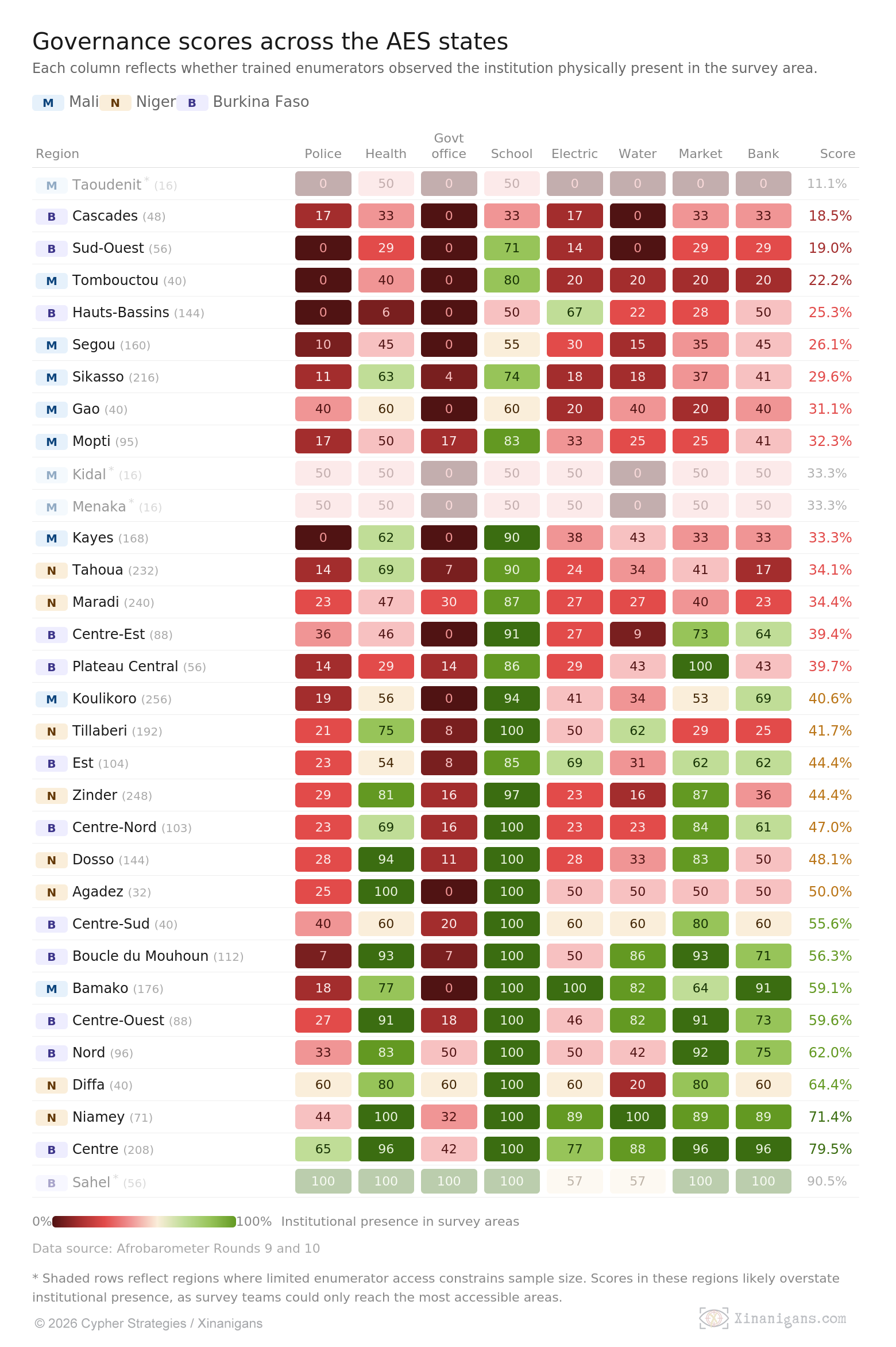
It is an architectural problem: who builds the institutional infrastructure that populations depend on, what functions it performs, and who holds leverage over the systems through which resources flow, disputes are resolved, and daily life is organized.
In other words, it asks who is doing the governing and how the architecture is built, before it asks whether that governance is “good” or “bad” by external standards. That shift produces a different analytical output.
Governance through this lens refers to the institutional organization of social and material life – the rules, routines, and forums through which people resolve problems and access resources – regardless of whether the actor exercising it is internationally recognized, democratic, or normatively legitimate.
The research on this is clear and accumulating. A NUPI study on jihadist governance in the Sahel documents that insurgent groups do, in fact, govern – providing mobile courts, intervening in resource disputes between farmers and herders, and developing institutional relationships with communities. Similar findings appear across fieldwork in central Mali and Burkina Faso, where researchers consistently describe jihadist actors stepping into roles once played by local state institutions. JNIM, al-Qaeda’s primary Sahel franchise, has built its recruitment base by positioning itself as a responsive governing entity that arbitrates local disputes and co-opts local leaders. In central Mali, jihadists intervened to adjudicate conflicts between farmers and herders over land rights – the kind of foundational governance function that the state had ceased to perform. The NUPI researchers treat this as a finding. But it is actually the diagnostic key to the entire problem: the actor who is resolving disputes and structuring daily life is, by definition, winning the contest over administrative terrain.
This is where the mainstream analysis breaks down most completely. The conventional frame assumes the state is the rightful governance actor and the insurgency is the aberration to be eliminated. It never asks the prior question: who is currently governing in the areas where the state is absent? When the answer is uncomfortable – when the entity performing dispute resolution, resource allocation, and institutional order is a jihadi organization – the conventional frame consistently processes it as a threat to be destroyed. The right question is different: what administrative functions is this actor performing, and what happens to the vacancy when those functions are removed without replacement?
This is uncomfortable. It should be.
Security dynamics, ideology, and regional rivalries all matter, but they operate inside a more basic condition. The insurgency is not filling a security vacuum. It is filling an administrative vacancy. That governance may be coercive, extractive, ideological, or violent. The operative variable is not moral legitimacy but whether an actor structures daily life where the state does not. And in many rural areas across the Sahel, the insurgency is the only actor doing so.
Every external actor that has entered the region brought security tools to contest this problem. France brought counterterrorism operations. The United States brought drone surveillance and special forces training. Russia brought mercenaries. None of them brought governance architecture. The vacancy remained. The violence adapted.
The institutional architecture that once provided at least partial coverage, however imperfect, has been actively dismantled. The Alliance of Sahel States, formed by Mali, Burkina Faso, and Niger after their withdrawal from ECOWAS, replaced a functioning regional framework with an institutional shell that has no administrative depth, no cross-border governance mechanisms, and no capacity to perform the functions that ECOWAS – for all its limitations – at least attempted. Russia cheered this restructuring. It produced a governance architecture Moscow could operate inside. It also widened the vacancy.
Russia’s failure is the cleanest proof case because the timeline is compressed and the intentions are undisguised. Moscow had zero interest in building administrative terrain. It wanted extraction access and regime insulation. So it hardened the military posture of regimes whose legitimacy was already collapsing while leaving the governance vacancy entirely intact. The insurgency’s structural foundation – the absence of the state as an institution populations interact with – never shrank. The numbers continued to climb after Russia arrived, just as they climbed after France arrived, just as they climbed after the United States arrived. In late April 2026, a suicide bomber killed Mali's defense minister. Within days, Malian and Russian forces began withdrawing from towns and bases across the north. The pattern did not slow. It accelerated. When the outcomes converge this consistently, the explanation has to change.
Six Months of Peace, Then an Invasion
In mid-2006, the Islamic Courts Union consolidated control over Mogadishu and much of southern Somalia. The period under ICU governance is widely documented as the most stable Somalia had experienced since the state collapsed in 1991, with researchers and international monitors noting a sharp drop in urban violence. The international airport and seaport reopened after more than a decade. Weapons disappeared from the streets. Hundreds of illegal checkpoints – the physical infrastructure of warlord extraction – were dismantled, and transportation costs on key trade corridors reportedly dropped by half. Traders described it as a golden era for overland commerce. The courts adjudicated disputes, regulated traffic, arrested militia members, and issued currency that researchers found still circulating nearly two decades later.
Six months later, a US-backed Ethiopian invasion dismantled the ICU. The governing logic was straightforward: an Islamist governance structure was, by definition, a threat – regardless of what it was actually producing on the ground. The administrative vacancy that followed the ICU’s removal was deeper than the one that preceded it. The remnants of the Courts fractured. The most extreme faction consolidated. Al-Shabaab emerged – structurally worse by every metric the intervention claimed to care about.
Nothing in the Sahel record, or in Somalia’s, prescribes what fills an administrative vacancy. No particular institutional form deserves protection. The insistence is more fundamental: the vacancy is the operative variable. When an external actor destroys functional governance without replacing its administrative functions, the result is a deeper vacancy that worse actors fill. Across the record, this sequence repeats often enough to count as pattern, not anomaly.
That pattern is now playing out across the Sahel in slow motion.
Security Wrapped Around Something, Not Deployed Into Nothing
There is one external actor in the region that is not leading with military force and is, consciously or not, engaging the administrative vacancy rather than just the security symptoms.
China is not deploying combat troops to the Sahel. It is doing something different: bundling security provision with infrastructure financing, police and gendarmerie training, surveillance systems, and capital investment. At the 2024 Forum on China-Africa Cooperation, Beijing pledged training for 6,000 military personnel and 1,000 police officers alongside roughly 51 billion dollars in new funding under the Beijing Action Plan. Chinese private security contractors – focused on defensive site protection rather than combat – guard energy projects and mining installations, including Niger’s Agadem–Seme oil pipeline.
This is not altruism. It is governance architecture constructed around Chinese commercial interests. Beijing is deliberately building administrative terrain around its priority corridors and then wrapping security around that terrain. The mainstream governance literature has no way to make sense of this observation, because its categories are normative: it asks whether governance is “good” or “democratic” or “accountable.” By those measures, China’s Sahel engagement scores poorly. But the structural effect is different from anything France, the United States, or Russia produced. China is building institutional infrastructure that populations interact with – roads, pipelines, communications networks, training academies – and wrapping security around it rather than deploying security in the absence of it.
The distinction matters. Rather than resolving the region’s governance crisis wholesale, Beijing is constructing selectively functional administrative terrain around strategic corridors and commercial infrastructure aligned with Chinese interests.
The mineral corridors that Beijing is constructing across the continent are not just supply chains. They are administrative terrain: institutional architectures that determine how resources flow, how disputes are adjudicated, and who holds governance leverage over the systems that populations depend on – the very terrain that is vacant in the Sahel’s rural peripheries. In a region where every military-first intervention has failed for the same structural reason, China’s approach – whatever its motives – produces a different footprint because it begins from a different premise.
China has not “solved” the Sahel. Beijing’s own experience is testing the limits of development-as-security in the face of escalating insurgency. The model has vulnerabilities. But the comparison reveals the structural logic: actors who build administrative terrain, even imperfectly, produce more durable outcomes than actors who deploy force into an administrative vacancy and expect the vacancy to close by itself.
The Output Will Not Change
The Sahel has had three major external military interventions. What it needs now is a different diagnosis.
The next engagement strategy that enters this region will reproduce the same failure pattern unless the analytical framework shifts first. As long as policymakers see a security problem, they will reach for security tools. As long as the tools are aimed at kinetic terrain, the administrative vacancy will persist. As long as the vacancy persists, the population will orient toward whoever fills it – and they will not ask whether that actor carries the right flag or governs through the right institutional form. They will ask whether it resolves their disputes, adjudicates their land claims, and provides a structure within which daily life can function.
The United States is now exploring a return. The approach under discussion links resumed security cooperation and intelligence sharing to concessions on gold, lithium, and uranium. It is a different flag on the same assumption. Unless the framework changes, the fourth intervention will produce the fourth data point.
The Sahel reveals what happens when the vacancy, not the violence, is the variable no one is watching. The violence is the output. The vacancy is the architecture. Until the architecture becomes the object of engagement, the output will not change.
Excellent analysis as usual. Could you look at Burma/Myanmar through a similar lens with China as the key stakeholder who has both the strategic and economic incentives to have a peaceful country on its borders?