

The Corridor Architecture of Global Power
Energy corridors and the administrative terrain of great-power competition


Venezuela, Iran, Iraq, and the Arctic are usually treated as separate crises. In practice, they are nodes under pressure along a shared architecture: a small set of corridors through which global energy moves and around which governance systems have been quietly organizing for two decades. Most analysis approaches these theaters through familiar lenses – sanctions enforcement, regional instability, maritime security, nuclear escalation. Mapped against global energy flows, they resolve into something else. What is being contested across these theaters is the governance systems embedded along the routes by which global energy travels.
Global energy moves through structured corridors, and those corridors now extend far beyond energy alone. They form the geographic skeleton through which multiple strategic systems move. Energy offers the clearest window into how governance architecture takes shape along this skeleton.
Early geopolitical theory treated geography as the decisive structure of power. Halford Mackinder argued that control of the Eurasian “Heartland” would determine global dominance. Today, the decisive structures have shifted from continental landmasses to the governance systems embedded along the corridors through which global energy flows. Those corridors now organize much of the terrain on which strategic competition unfolds.
Energy Corridors as Terrain
A small number of corridors organize a large share of global energy movement and, with it, most of the global economy’s exposure to supply disruption. The Indo-Pacific Corridor moves hydrocarbons from Middle Eastern and African producers eastward through the Strait of Hormuz, across the Indian Ocean, through the Strait of Malacca, and into the consumption centers of East and Southeast Asia. It carries the energy requirements of the world’s most populous economies. Disruption anywhere along its length produces cascading economic consequences across the eastern half of the international system.
The Middle East-Europe Corridor moves energy northward and westward, through Hormuz, across the Arabian Sea, through Bab el-Mandeb and the Red Sea, through Suez, and into Mediterranean and European markets. It is the corridor most exposed to regional instability in the Gulf and the Horn of Africa, and the one most directly affected by the current conflict geography in and around Iran.
The Atlantic-Americas Corridor connects Caribbean and South American producers through Panama and Atlantic shipping routes to global markets. Venezuela, Brazil, Ecuador, and the Gulf of Mexico are its principal production nodes. It is the corridor most proximate to the United States and the one where Chinese governance footholds have most directly collided with traditional US regional influence.
These corridors are heuristic rather than exhaustive. Global energy flows are more networked and redundant than any three-route framing can capture. But these corridors organize much of the world’s supply and most of its strategic exposure, which is what makes them the relevant structural unit
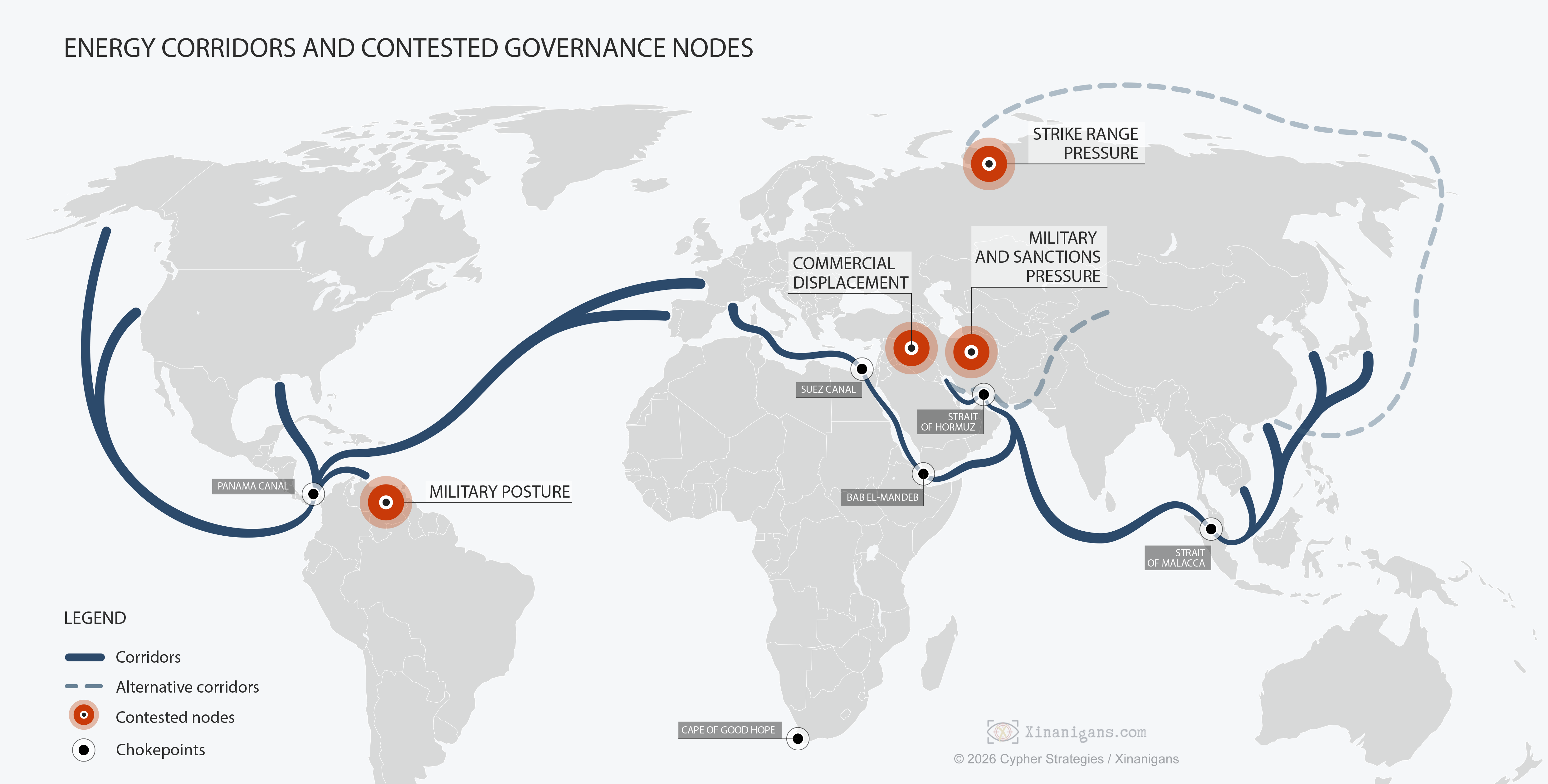
Each corridor consists of three layers. The resource layer is the one analysts typically discuss: production fields, reserves, extraction capacity. The transport layer is the one militaries typically focus on: chokepoints, shipping lanes, naval access. The third layer receives the least analytical attention and carries the most strategic weight. It is the administrative layer: the financing structures, contract architecture, port concessions, joint ventures, regulatory frameworks, and political relationships that determine who governs the corridor systems through which energy actually moves.
The administrative layer is where the competition is being decided.
The Governance Architecture
Every pipeline, terminal, and port concession exists inside a legal and administrative system that determines who controls access, who captures revenue, who absorbs risk, and who exercises leverage when relationships become stressed.
Energy systems at the corridor level combine multiple administrative structures. Financing arrangements create long-term debt relationships between states and institutions. Contract structures embed obligations lasting decades. Port concessions extend administrative presence into sovereign territory. Joint ventures integrate foreign firms into domestic production and regulatory systems. Patronage networks tie local political and economic elites to the continuation of existing arrangements.
These systems construct political relationships that persist independently of the governments that originally signed the agreements. A state that has financed its port infrastructure through Chinese state banking, structured its energy-sector joint ventures with Chinese firms, and embedded its regulatory systems in Chinese technical standards faces a different set of political constraints than one whose administrative architecture runs through Western institutions. That difference is administrative rather than ideological. It operates continuously, shaping the option space available to governments long before any crisis requires them to make explicit alignment choices.
This is the mechanism through which energy governance shapes geopolitical outcomes: the accumulation of administrative dependencies that narrow the choices available to states when contingencies arrive.
China’s Corridor Strategy
China’s energy investment pattern across the Belt and Road Initiative is frequently analyzed as supply diversification – a rational response to import dependence and the vulnerability of long maritime supply lines. Supply diversification is part of the picture. The governance architecture embedded across this investment pattern is the larger part.
When Chinese energy investments are mapped by administrative structure rather than by volume, a different pattern emerges. Chinese state banks extend oil-backed financing that ties debt repayment directly to commodity flows, creating financial entanglement that persists through political transitions. Chinese firms take joint venture positions in production fields, embedding technical and operational integration that is costly to unwind. Chinese construction and logistics firms build and operate port infrastructure under concession agreements that extend administrative presence into corridor chokepoints. Chinese telecommunications firms provide the network infrastructure through which energy-sector operations are monitored and managed.
The cumulative effect functions as a governance architecture whether or not it was designed as one. A distributed system of administrative footholds has emerged across corridor nodes, shaping how those nodes function and who exercises leverage over them.
Four corridors have emerged from this investment pattern. Two of these four overlay the global corridors identified above. Two are alternative routes China is constructing to reduce exposure to maritime chokepoints where US naval presence concentrates. The Middle East-to-Western China corridor secures land-and-sea supply routes through Iran, Iraq, Pakistan’s Gwadar port, and into Xinjiang. The Russia-Arctic corridor develops LNG infrastructure at Yamal and Arctic LNG-2, creating polar supply routes less exposed to traditional interdiction points. The Africa maritime corridor builds oil-backed loan relationships and port infrastructure from Angola and Nigeria through Mozambique and Djibouti, embedding governance footholds along the western approach to the Indo-Pacific corridor. The Latin America corridor extends Chinese administrative presence into the Atlantic-Americas corridor through Venezuelan oil financing, Brazilian and Ecuadorian energy partnerships, and port infrastructure investment.
The pattern across all four corridors is consistent: redundant governance footholds across multiple nodes mean that pressure on any single node leaves the broader architecture intact. This redundancy, whether engineered deliberately or emerging from accumulated investment patterns, makes Chinese corridor presence resilient to the kind of node-level pressure that US strategy has historically applied effectively against more concentrated dependencies.
The Counter-Architecture
The United States built its global posture from a different strategic logic. It emerged from Cold War containment, alliance commitments to specific partners, and an interest in stabilizing the global energy markets on which the postwar economic order depended. The Gulf basing structure was built around the Carter Doctrine and the Soviet threat. The Indo-Pacific naval presence organized around alliance commitments to Japan, South Korea, and later the network of partners that emerged from the hub-and-spoke system. Caribbean influence reflected both Cold War anti-communism and longstanding hemispheric doctrine.
When mapped against global energy corridors, however, these structures collectively perform a corridor-stability function. US naval presence in the Gulf sits astride the Hormuz chokepoint connecting Middle Eastern production to both the Middle East-Europe and Indo-Pacific corridors. Mediterranean and Red Sea presence covers the northern reach of the Middle East-Europe corridor. Indo-Pacific fleet positioning covers the Malacca chokepoint and the eastern terminus of the Indo-Pacific corridor. Caribbean presence sits at the northern approach to the Atlantic-Americas corridor. What appears, through conventional lenses, as a collection of bilateral relationships and regional commitments resolves into a counter‑architecture: a set of structures that collectively condition access to the transport layer of global energy movement.
The asymmetry between the two architectures is strategically significant and rarely named directly. China’s corridor architecture, whether built by deliberate design or by the accumulation of state-aligned commercial and financial activity, developed the administrative governance layer in parallel with the physical infrastructure. Each financing arrangement, joint-venture structure, and port concession contributes administrative depth at the node level. The US counter-architecture performs its corridor-stability function primarily at the transport layer – through naval access, chokepoint presence, and maritime security guarantees – with limited administrative depth inside the corridor nodes themselves. US presence can condition access to the transport layer. Replicating the administrative entanglement that Chinese governance footholds have constructed inside the resource and administrative layers requires different tools than naval presence provides.
That asymmetry is the structural problem. Contesting Chinese corridor architecture requires operating at the administrative layer. Transport-layer contestation alone produces limited effect. The administrative layer is terrain where the United States is only now beginning to compete, as the recent pressures visible at corridor nodes suggest.
The Alignment Calculus
States make coalition decisions inside the constraints of administrative systems already in place. Those systems determine what disruption would cost, how quickly alternatives could be constructed, and what the domestic political consequences of realignment would be.
Consider a mid-tier Southeast Asian state with significant Chinese infrastructure financing, energy-sector joint ventures with Chinese firms, and port operations partially managed by Chinese logistics companies. Its government is friendly to Washington and has historical security relationships with the United States. When a regional contingency arrives that requires it to make an explicit alignment choice, the decision occurs inside a cabinet where the relevant ministries are running a different calculation simultaneously.
The finance ministry is asking: if we publicly align with the United States, will Chinese state banks freeze the financing tranches currently supporting three major infrastructure projects? The energy ministry is asking: will joint-venture partners withdraw technical personnel from production operations that our domestic workforce lacks capacity to run independently? The transport ministry is asking: if Chinese logistics firms exit our major port, do we have the operational capacity to maintain throughput? The economics ministry is asking: what happens to domestic energy prices if the supply arrangements currently running through Chinese-administered channels are disrupted faster than alternatives can be arranged?
These are administrative questions. They have administrative answers determined by the governance architecture already in place before the contingency begins. The security guarantee and political preference operate inside those answers rather than above them.
This is the operational mechanism. Alignment decisions are made under the weight of administrative systems that encode dependency, distribute risk, and determine what disruption costs in concrete institutional terms. A state whose energy-governance architecture runs through Chinese institutions faces a structurally different alignment calculus than one whose administrative systems connect to Western institutions. The difference reflects the material consequences of disruption on each side.
China has been building that asymmetry for two decades. The corridor architecture is the instrument. The alignment calculus is the objective.
The Pattern Across the Nodes
When recent geopolitical pressure is mapped against corridor architecture, a pattern of contestation becomes legible that event-by-event analysis obscures.
Venezuela is a governance node inside the Atlantic-Americas corridor. Chinese state banks hold oil-backed loan positions representing tens of billions in exposure. Chinese firms hold joint-venture positions across production fields. Chinese telecommunications infrastructure is embedded in state security systems. Pressure on Caracas – culminating in Nicolás Maduro’s removal and detention and the installation of an interim government – is simultaneously pressure on the administrative architecture China has constructed at this corridor node: the financing structures, the contract relationships, and the operational integration that would need to be unwound or renegotiated under any successor administration. The military posture deployed to the Caribbean, with its amphibious, strike, and fifth-generation air assets, coincides with pressure on the governance architecture China has built at this node.
Iran is a different type of node. Chinese presence operates through the 25-year Comprehensive Strategic Partnership rather than loans-for-oil structures. The partnership establishes a governance framework across infrastructure investment, telecommunications integration, sanctioned supply channels, and regional logistics access, though activation has been uneven under sanctions pressure. Iran also sits at the northern approach to the Hormuz chokepoint, the most strategically significant single point in the global corridor system. Sustained pressure on Iran – whether through military posture, sanctions escalation, or diplomatic isolation – is simultaneously pressure on Chinese administrative presence at a node that conditions access to two major corridors.
Iraq represents a third node type, one where the contest is occurring through commercial rather than military instruments. Chinese firms hold major positions across Iraqi upstream production, with significant involvement in midstream services and export infrastructure. The return of ExxonMobil, Chevron, and other US firms to Iraqi energy sectors, actively encouraged by the current Iraqi government and received favorably in Washington, can be read as corridor-node competition conducted through contract and investment architecture rather than military pressure. The objective is the same: displace or complicate Chinese administrative presence at a node whose governance structures shape corridor access.
Arctic LNG is the fourth visible node. Chinese participation in Yamal and Arctic LNG-2 creates governance footholds along the Russia-Arctic corridor, the supply route specifically designed to reduce Chinese energy exposure to maritime interdiction. Increased US attention to Arctic infrastructure, including expanded strike range and the Arctic Sentry NATO activity launched in early 2026, places Chinese governance footholds in the Russia-Arctic corridor under conditions of elevated strategic visibility.
Taken together, these theaters resolve as a pattern of pressure applied at administratively vulnerable nodes across China’s corridor architecture, simultaneously stressing the governance footholds China has constructed and testing whether the administrative layer can be contested as effectively as the transport layer.
What the Force-Posture Debate Misses
The pattern visible above raises a question that the force-posture debate largely misses. Transport-layer military advantage and node-level administrative influence operate through different mechanisms. A state can hold decisive military superiority along a corridor and still find that the governance architecture at corridor nodes has shaped alignment decisions before military instruments become relevant.
The debate over Taiwan deterrence illustrates the gap. It has been conducted almost entirely at the transport and military layers: carrier strike groups, missile ranges, basing access, escalation thresholds. Those variables matter. But deterrence also has a governance layer. If the states whose geography, logistics, and political support would be required for effective coalition operations have energy governance architectures that make alignment costly before the first military move occurs, then deterrence has already been partially eroded at the administrative level regardless of the military balance.
The energy dimension is central because energy systems create the deepest and most durable administrative dependencies – the ones most difficult to unwind quickly, most consequential to domestic political stability if disrupted, and most likely to shape alignment calculations when contingencies arrive.
The competition visible in Venezuela, Iran, Iraq, and the Arctic appears to be the first sustained US engagement with China specifically at the administrative layer of corridor governance in third countries. Administrative-layer competition through sanctions architecture, financial system governance, and trade law has been a continuous feature of US posture. What may be new is contestation of Chinese corridor presence at the node level through instruments other than sanctions alone. Whether it reflects a coherent strategic doctrine or the convergent effect of institutional incentives and shared threat perception operating independently across theaters is, for the moment, less important than recognizing what kind of competition it is.
It is contestation of the governance architecture through which strategic alignment is being constructed – corridor node by corridor node, administrative layer by administrative layer – in advance of the contingencies that will determine whether that architecture holds.
Events in Venezuela, Iran, Iraq, and the Arctic appear, through familiar analytical lenses, as separate crises driven by separate logics. Mapped against global energy corridors, they resolve into something more coherent: pressure applied at specific nodes within competing governance architectures that have been organizing themselves around the same terrain for two decades.
Energy flows make the architecture visible. Governance structures determine its strategic consequences. The decisive terrain is administrative. The competition is already underway.
Very very interesting. Insightful. It's making sense for me of other thinkers in this space in recent years - e.g. Thomas Barnett. Good to breathe new life into this for me with new insights.