


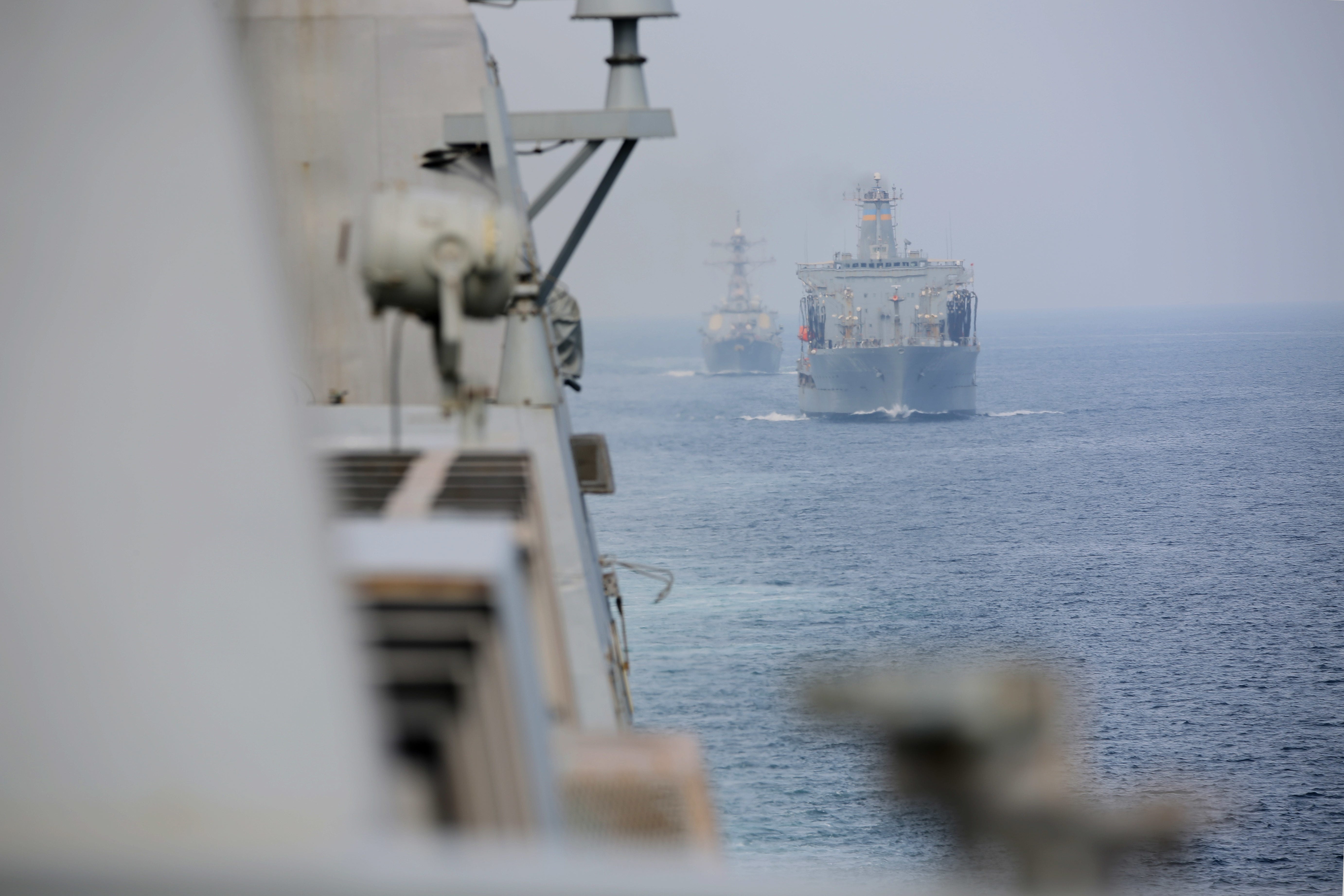
Foreign Affairs published an assessment of the war yesterday that represents, by both credentials and access, the ceiling of what the American policy establishment can produce on this crisis. The diagnosis is sharp. Iran’s three traditional security pillars have been systematically destroyed: Hamas and Hezbollah decimated, nuclear infrastructure buried, and the missile program degraded. But Iran discovered a fourth instrument more powerful than the other three combined. The analysis names the mechanism precisely: Iran attacked two ships, spooked maritime insurers into pulling coverage, and collapsed commercial transit through the Strait of Hormuz without needing to sustain a military campaign. The piece titles a central section “Battle of the Bridge Trolls,” capturing the toll-collector logic in a single image.
Dozens of ships have paid Iran to transit. The toll system functions simultaneously as a revenue stream and a security guarantee, replacing the deterrence Hezbollah once provided. The United States responded with a counter-blockade that mirrors Iran’s own move. Iran’s systemic domestic problems remain unfixed. The war gave the regime a temporary reprieve it did not earn through governance performance. Coercion has not produced capitulation and likely will not. Both sides are misreading each other. Maximalist positions are reducing the chance of settlement.
The analysis sees all of this. Everything it describes is a governance problem. The prescription, however, is entirely diplomatic.
The recommendation: end the war, prepare a clear vision of what the United States wants, and hope that Iran’s next leader chooses a better path. This is the analytical equivalent of diagnosing a structural fault and recommending better curtains. It is not factually wrong. It is incomplete in a way that forecloses the most consequential design space available.
The gap is visible in the article’s own evidence. Iran does not need to sink ships. It needs to make the administrative conditions of transit unworkable. Insurance markets, not naval power, are the enforcement mechanism. The toll system is a governance instrument: it sorts access by willingness to pay and, implicitly, by relationship to Tehran. The counter-blockade is a second governance instrument pointed in the opposite direction. What is contested here is not the water. It is the administrative architecture that determines whether the water is commercially usable.
This is administrative terrain. The Strait of Hormuz has become a space where governance leverage, not firepower, determines who can operate, on what terms, and at what cost. Iran did not seize a military position. It inserted itself into the governance layer of global maritime commerce and made itself an unavoidable node in the system that regulates passage. The Foreign Affairs analysis identifies every component of this structure. It does not identify the structure itself.
That identification changes the design space for a solution.
Inside the conventional frame, the options are coercion (which has failed), concession (which validates the endurance strategy), or patience (which cedes initiative to Tehran’s internal timeline). These are the only moves available when the problem is understood as a test of wills between two negotiating parties.
Inside a governance warfare frame, a fourth option becomes visible: restructure the administrative terrain so that Iran’s endurance strategy loses its governance leverage regardless of Tehran’s resolve.
This means, first, decoupling the maritime governance architecture from the geographic chokepoint. Iran’s leverage depends on the assumption that Hormuz is the only administratively viable corridor for Gulf energy exports. Every alternative that creates a parallel pathway for the same commercial function, whether pipeline capacity to non-Hormuz terminals, expanded transshipment infrastructure, or rerouted insurance and logistics frameworks, reduces the governance leverage the geographic position confers. This is not a military bypass. It is a terrain modification. The goal is not to defeat Iran’s capability at the strait but to make the terrain it occupies less consequential.
Second, it means building multilateral administrative structures around strait transit that dilute Iranian unilateral leverage. Convoy coordination mechanisms, insurance frameworks, maritime safety regimes, all structured so that Iran can participate but cannot exercise veto authority. This addresses the legitimacy demand driving Iranian maximalism without conceding control.
Third, it means using the leadership transition not as a waiting period but as a window to reshape the administrative terrain Iran’s next leader inherits. The Foreign Affairs prescription treats the transition as a pause, a period when transformational deals are off the table and the United States can only prepare an offer. A governance warfare approach treats the transition as the most consequential design window available. Whoever consolidates power will inherit the terrain as they find it. Change the terrain during the transition and you change the menu of viable strategies available to the next regime, regardless of who emerges or what they prefer.
The question this analysis raises but cannot answer is how the United States achieves its objectives without reinforcing Tehran’s belief that endurance, not a negotiated settlement, is the winning strategy. The governance warfare answer: stop contesting on the axis where endurance works. Endurance wins in a coercion standoff. It does not win when the administrative terrain underneath you is being restructured so that what you are enduring for depreciates in value while you hold it.
You do not outmatch their resolve. You make their resolve strategically irrelevant by changing what the terrain rewards.
This is not a failure of intelligence or effort. The Foreign Affairs analysis is serious and detailed, written from inside the room where these negotiations have been shaped. The limitation is structural. The field has not produced the category that connects the insurance mechanism, the toll system, the deterrence function, and the administrative collapse of commercial transit into a single legible frame. Every component of the governance architecture is visible in the article. The architecture itself is not, because the vocabulary for it does not yet exist in the analytical mainstream.
But it does exist. The framework is called governance warfare. And the exit that the conventional frame cannot find is already visible in the evidence it has produced.