


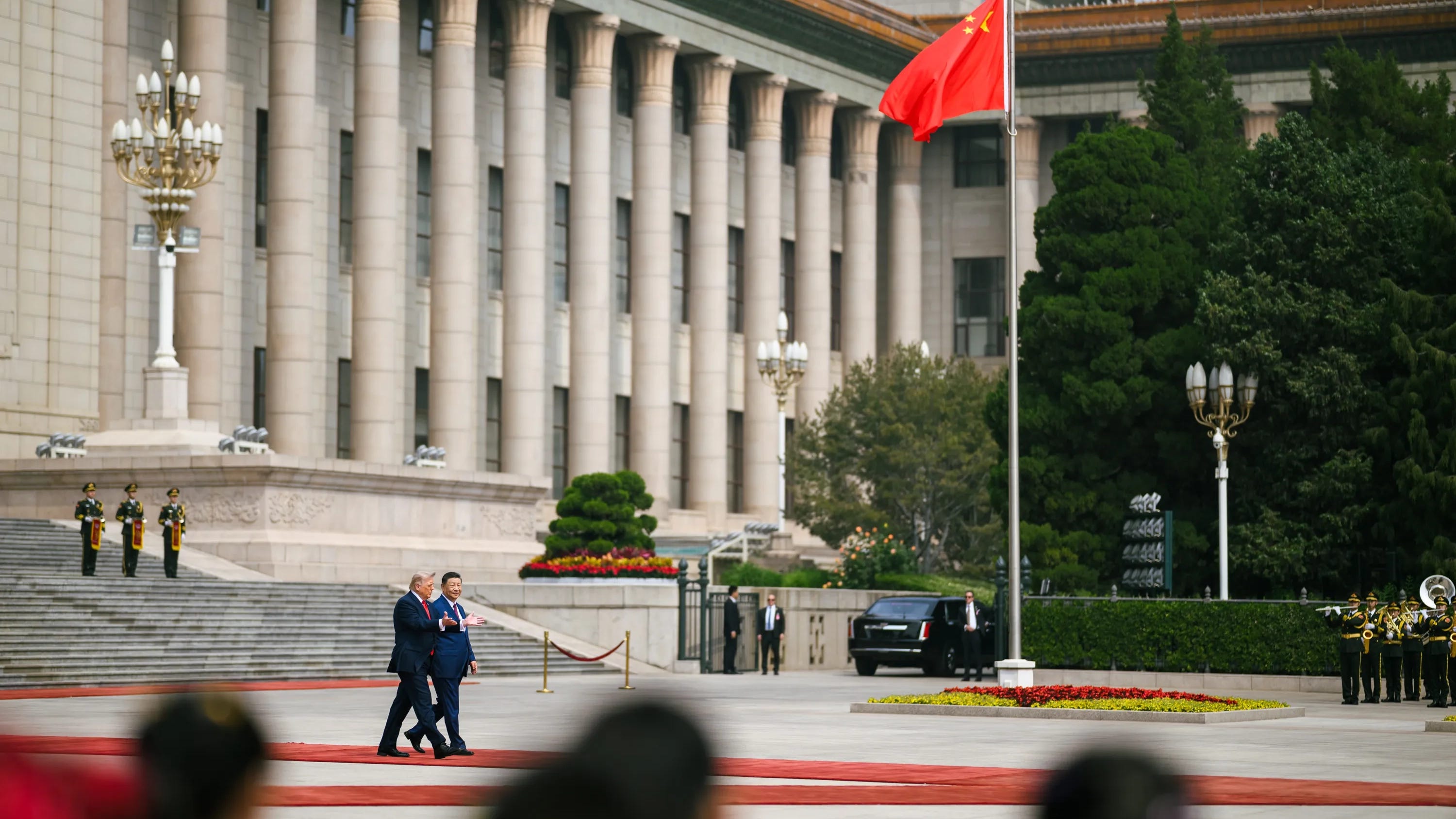
Xi Jinping opened the Beijing summit with a single sentence. “Can China and the United States overcome the so-called ‘Thucydides Trap’ and create a new paradigm of major-country relations?” He delivered it in the Great Hall of the People, on state television, before President Trump had spoken. Since then, Western analysts have spent the week explaining what the phrase meant, debating whether the trap was real, and distributing the frame to every audience Beijing could not have reached on its own.
That is the operation. And almost no one covering it recognized it as one.
The standard read across the commentary spectrum, from Bloomberg to the Daily Caller, treated Xi’s invocation as a signal. The hawks heard a threat. The doves heard an invitation. The strategic-culture analysts heard civilizational messaging directed at a narrow audience of senior policymakers. Each interpretation accepted the same premise: Xi was communicating something, and the task was to decode what he meant.
The governance warfare read is different. Xi was not signaling. He was constructing terrain.
The Thucydides Trap, as popularized by Graham Allison, posits a structural dynamic between rising and established powers. The rising power’s ascent creates fear in the established power, and that fear drives escalation. The causal engine sits with the established power’s anxiety. Every time Beijing activates this frame in the international discourse, it assigns roles: China is Athens, the dynamic and ascending civilization. America is Sparta, the fearful and reactive incumbent. And the frame’s own internal logic makes American strategic anxiety the dangerous variable, not Chinese revisionism. Any American assertion becomes evidence of Spartan fear. Any American restraint becomes evidence that Beijing’s framing worked. There is no American move within the frame that does not confirm it.
When a framework has no falsifiable response from one side, you are not looking at analysis. You are looking at a constructed decision environment.
Xi has been building this particular piece of terrain for over a decade. In 2013, he told international leaders that the trap should be avoided. In 2015, in Seattle, he said there was “no such thing” as the trap’s inevitability. In 2026, at the summit, he posed it as a live question: “Can we overcome it?” The shift from rejection to open question is itself the signal most analysts missed while looking for signals in the content. Beijing has moved from “this does not apply to us” to “this might apply to us, and your behavior will determine whether it does.” The move from denial to conditionality relocates agency onto the United States. China defines the structural risk. America bears responsibility for managing it. That is not diplomacy. It is responsibility assignment as a form of control. The frame now carries an implicit ultimatum, and it arrived pre-legitimized by an American academic institution.
The most sophisticated commentary this week understood some of this. One widely circulated national security assessment, published the day after the summit, correctly identified the Thucydides reference as deliberate strategic signaling rather than academic ornamentation. It accurately described Beijing’s shift from retaliation to conciliation as sequencing rather than capitulation. It mapped Xi’s moves since 2012 as a coherent positional campaign. It even introduced the Go-versus-chess framework as a corrective to American tactical thinking. Its core proposition was that Xi was offering Washington a choice: accept China as a coequal civilizational power with red lines that cannot be crossed, or continue drifting toward collision.
And it still arrived at exactly the conclusion Beijing’s architecture was designed to produce.
The assessment’s endpoint was a tacit G-2 partition: mutual recognition of core strategic zones, reduced ideological confrontation, American acceptance of Chinese regional primacy. That is not an independent analytical conclusion. That is the predetermined exit of the decision environment Xi constructed. The Thucydides frame offers two endpoints: war or accommodation. The assessment, correctly, did not want war. So it followed the architecture to the accommodation exit and described what it found there as discovery rather than destination.
This is where the chess-versus-Go analogy, offered as a corrective, becomes its own form of capture. Go is a useful shorthand for positional strategy. The problem begins when it migrates from tactical metaphor to civilizational explanation, because at that point it stops describing how Beijing sequences moves and starts distributing Beijing’s preferred account of why those moves always succeed. The “patient civilizational Go player” is the self-portrait Beijing has cultivated for Western analytical consumption for decades.
Adopting it as an analytical lens means accepting Beijing’s preferred description of its own strategic character as an objective observation. It also makes Chinese strategy unfalsifiable. Every reversal becomes evidence of deeper patience. Every overextension becomes a temporary position in a longer game the observer lacks the civilizational depth to perceive. When an analytical claim about an adversary makes their strategy impossible to assess as failing, the claim is not doing analysis. It is distributing deterrence narrative.
The actual record since 2012 is more ambiguous than the Go metaphor permits. The anti-corruption purges were factional warfare with institutional byproducts. Belt and Road produced a trail of debt distress, backlash, and write-downs across multiple continents. South China Sea militarization provoked exactly the alliance consolidation that a patient positional player would have anticipated and avoided: AUKUS, Quad hardening, Japanese rearmament, Philippine basing access. These are not the outcomes of a player who has been quietly encircling the board. They are the outcomes of a system that has made serious strategic miscalculations and is now managing the consequences.
The Go frame cannot say this. The governance warfare frame can.
What happened at the Beijing summit was not a warning, an invitation, or a civilizational message. It was terrain construction executed through narrative infrastructure. Xi selected a pre-legitimized Western academic concept, delivered it in a controlled broadcast environment, sequenced it against the Taiwan ultimatum to close the logical circuit, and let the Western commentary ecosystem distribute the frame for free. Hawks and doves alike spent the week debating the content of the trap. The operation was the frame itself.
The question worth asking is not whether the Thucydides Trap applies to the US-China relationship. It is who built the terrain this conversation is happening on, and what decision space it forecloses.