


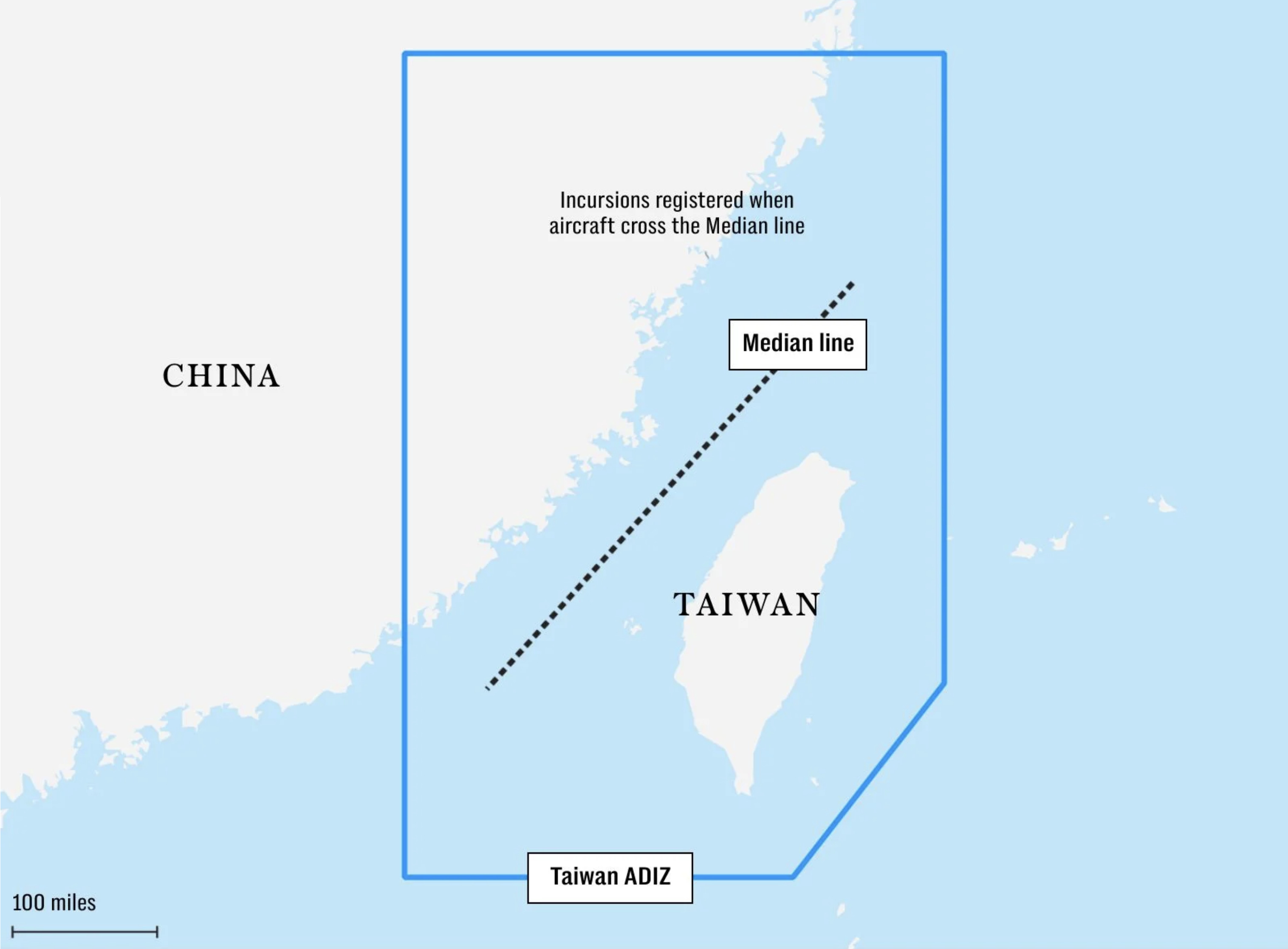
For several years, PLA air operations around Taiwan have followed a steadily intensifying pattern. Aircraft routinely entered Taiwan’s Air Defense Identification Zone (ADIZ) and crossed the Taiwan Strait median line, creating a persistent signal of Chinese military pressure.
In late February, that pattern abruptly stopped.
Beginning February 27, PLA aircraft largely ceased entering Taiwan’s ADIZ or crossing the median line for roughly a week; an unusual pause that immediately generated speculation among analysts about Beijing’s intentions. Observers proposed a range of explanations: weather conditions, seasonal operational cycles, political meetings in Beijing, internal military investigations, or preparation for a potential escalation.
None of these explanations has been entirely satisfying.
From a conventional military perspective, the central question becomes why the flights stopped.
A governance warfare perspective asks a different question: what political and institutional effects does the change in pattern produce?
Governance warfare focuses on how strategic competition operates through the manipulation of systems — political, bureaucratic, economic, and informational — rather than through military force alone. In this context, the value of coercive actions often lies less in their immediate tactical effect than in the institutional and psychological reactions they trigger.
Episodes like this illustrate a dynamic I have been exploring in recent writing: modern competition often operates through the manipulation of expectations and administrative systems long before force is applied.
For several years, PLA flights near Taiwan have gradually normalized a pattern of coercive presence. Aircraft incursions became routine, and analysts began to treat them as a standard feature of the strategic environment.
When coercive activity becomes predictable, its signaling value declines.
But when the pattern suddenly disappears, the analytical environment changes. Analysts begin publicly second-guessing their assumptions about Chinese military behavior. Political debates in Taiwan about defense spending and cross-strait posture suddenly occur in a different informational environment. Alliance observers begin asking whether the pause reflects a shift in Beijing’s signaling ahead of upcoming diplomatic engagements.
In other words, the absence itself becomes the signal.
This dynamic highlights an underappreciated feature of modern competition. Strategic pressure does not operate only through escalation. It can also operate through the disruption of established patterns.
Once a pattern of coercion becomes normalized, interrupting that pattern introduces uncertainty across multiple institutional systems simultaneously: domestic political debates, alliance signaling environments, and military planning assumptions.
This is what distinguishes governance warfare from ordinary strategic ambiguity. The objective is not merely to obscure intent, but to structure how institutions interpret and respond to the strategic environment.
And sometimes, the most revealing signal is not the pressure itself, but the moment it disappears.