


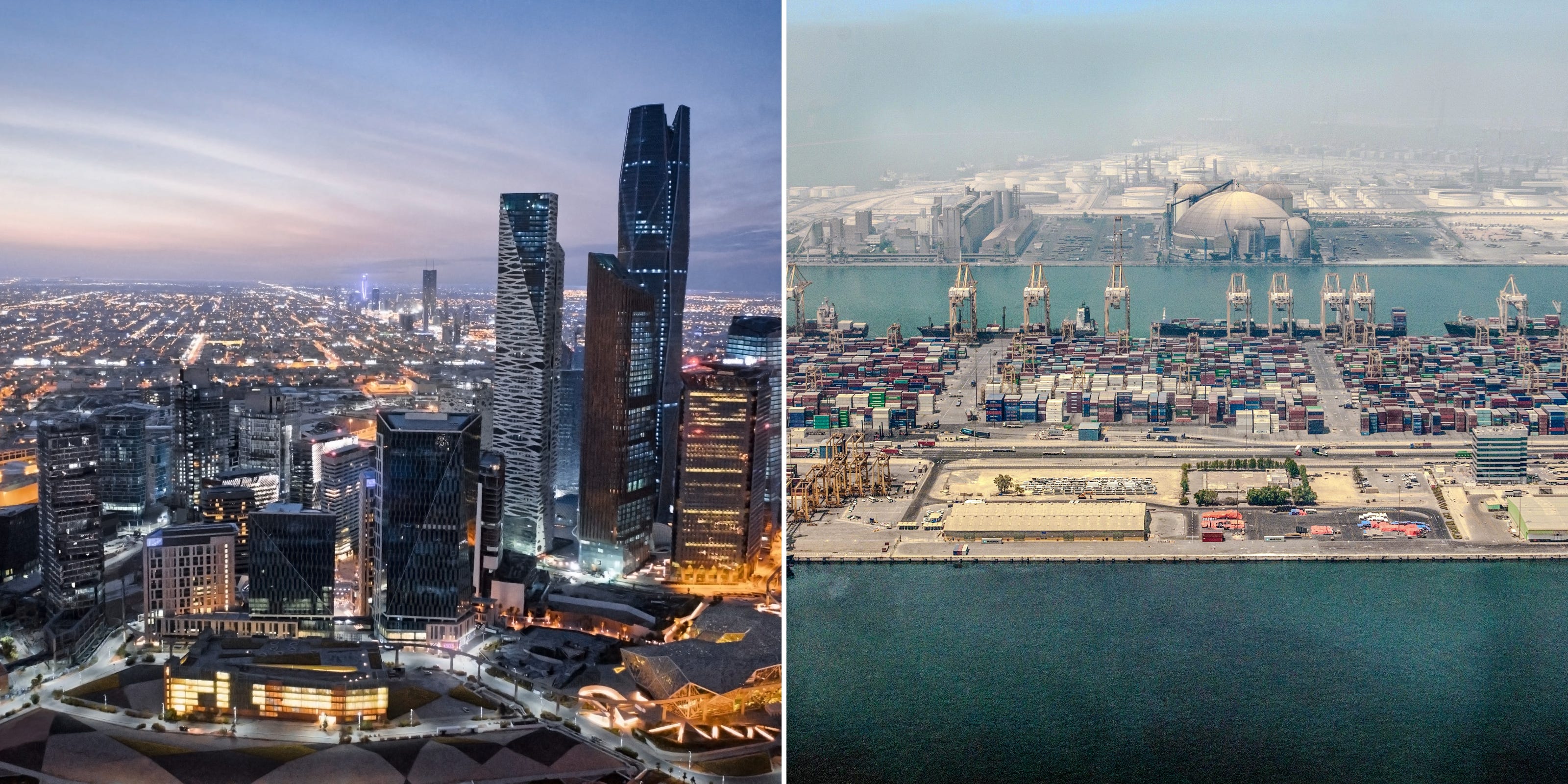
On April 28, the United Arab Emirates announced its withdrawal from OPEC and the wider OPEC+ alliance, effective three days later, ending a membership that began in 1967. Saudi Arabia, which designed the modern production coordination framework and anchors decision-making within it, absorbed the departure in silence and kept the system running. Under the same wartime pressure, the two states made opposite institutional choices: one remained at the center of an architecture it administers, while the other exited an architecture it would never control.
The exit gave public form to a divergence that had been building for years. Saudi Arabia and the United Arab Emirates operate under the same pair of constraints: an American security and financial order neither can replace, and a Chinese economic and technical order neither can refuse. Both responded by spreading dependencies across legal systems, jurisdictions, and institutions, and by governing the points where the two orders touch. Saudi Aramco sells crude through entities contracting under English, Singaporean, and American law while its wells answer only to Saudi concession; the same Abu Dhabi that operates an English common law financial center maintains cooperation agreements with the People’s Bank of China. States operating from such a similar logic might be expected to converge. Through the spring, they visibly diverged.
The explanation lies in what each state brought to the project. Saudi Arabia entered its construction decade with demographic weight, territory, energy reserves, and sovereign capital on a scale few states command, and with little of the domestic machinery required to convert those assets into production, technology, and sustained economic activity. The United Arab Emirates entered the same decade already holding the machinery: globally connected ports, airlines, free zones, financial jurisdictions, courts, and regulatory environments built for foreign capital, attached to a small population and a limited resource base. Each state is now building what it lacks.
The two projects have acquired distinct characters. Saudi Arabia pursues freedom of action through institutional depth, bringing more functions under Saudi rules and assembling more capability inside Saudi Arabia. The Emirates pursues it through optionality, adding pathways through institutions it controls, extending the markets those institutions can reach, and keeping alternatives available when one channel narrows. One state is creating capacity it never possessed. The other is converting capacity it already built.
The divergence shows in the institutions each state has built, in how those institutions absorbed the war’s pressure, and in the terms each now offers the firms and governments that engage it. Each design also carries a distinct vulnerability: Saudi institutions must learn to perform at the scale their ambitions assume, while Emirati institutions must preserve the confidence that keeps activity flowing through them. The comparison begins with what Riyadh is building.
What Riyadh Is Building
Vision 2030’s most consequential products are institutions. Since the program launched, Riyadh has created new companies, funds, regulatory authorities, economic zones, and procurement systems that change how capital and capability enter the kingdom. The legal system has been rebuilt alongside them. The investment law that took effect in February 2025 replaced a foreign investment regime dating to 2000 with a single framework covering local and foreign investors alike, moved market entry from licensing toward registration, established a national investor register, and codified protections including access to alternative dispute resolution. The law opens more of the economy to outside capital while concentrating oversight of that capital inside Saudi administrative systems. Participation widens on terms the state writes.
The capital markets follow the same design. In February 2026, the kingdom opened its main equity market to all categories of foreign investors, retiring the qualified investor structure that had filtered direct access since 2015, and two months later the Capital Market Authority approved a framework for special purpose acquisition companies on the Nomu parallel market. Each measure increases foreign participation, and each routes that participation through exchanges, registers, and rules that Riyadh controls. Foreign money arrives in greater volume through channels the state built and governs.
Riyadh applied the same logic to commercial dispute resolution. Saudi Arabia rebuilt its arbitration law in 2012 on the UNCITRAL model, then established the Saudi Center for Commercial Arbitration by cabinet decision to give the new law an institution capable of administering it. The center issued modernized rules in 2023 and seated an SCCA Court under the presidency of Jan Paulsson, among the most recognized figures in international arbitration, with independent authority over the appointment and challenge of arbitrators. The project’s purpose is clear from the design: commercial disputes that Saudi parties once sent abroad, to London or Paris or Singapore, can increasingly be resolved at home, under Saudi law, in an institution international counterparties can accept. Where Abu Dhabi imported a foreign legal system and built an enclave around it, Riyadh is upgrading its own legal system until the enclave becomes unnecessary.
In manufacturing, the state is building the conditions under which foreign technology becomes domestic capacity. A standardized incentives program launched in January 2025 with an initial allocation of ten billion riyals covers as much as thirty-five percent of initial investment in qualifying projects, with the first phase directed at chemicals, automotive production, machinery, and equipment the kingdom does not currently manufacture. Alat, the Public Investment Fund’s advanced manufacturing company, shows the model at scale. Its partnership with Lenovo, valued at two billion dollar, pairs the investment with a manufacturing complex inside the Special Integrated Logistics Zone in Riyadh, planned to produce millions of laptops, desktops, and servers for regional distribution. Lenovo contributes the technology, supply chains, and market access; Riyadh supplies the capital, incentives, infrastructure, and institutional setting. The resulting capability sits inside Saudi Arabia and becomes part of the Saudi system.
Artificial intelligence shows the same strategy at the technology layer. HUMAIN, launched by the Public Investment Fund in May 2025 with a mandate spanning data centers, cloud, models, and applications, negotiates with major foreign technology providers as a single national counterparty: NVIDIA processors for its first data centers, a multiyear collaboration with AMD sized at up to ten billion dollars and five hundred megawatts, and an expanded agreement making Amazon Web Services its preferred global partner across as many as one hundred fifty thousand accelerators. The pattern extends beyond HUMAIN. The fund, the Saudi Information Technology Company, and Microsoft signed a memorandum in November 2025 to explore sovereign cloud services under national controls on security, data residency, and compliance, and in January 2026 the government laid the foundation stone for Hexagon, a four hundred eighty megawatt state data center built to hold government workloads at national scale. The most advanced chips, much of the software, and much of the expertise still come from abroad, primarily the United States. Saudi institutions increasingly determine how foreign chips, software, and expertise are assembled, governed, and deployed inside the kingdom.
The war showed what this strategy cannot yet reach. Saudi Arabia entered the conflict months after signing a strategic defense agreement with Washington and being designated a major non-NATO ally, and the fighting began anyway, on a timetable set in Washington and Tehran, with Iranian retaliation putting Saudi territory and infrastructure at immediate risk. The systems that mattered most under fire were air and missile defense, intelligence, basing, and command integration. All ran through the United States, which made the American relationship more operationally necessary and more strategically costly in the same weeks. Riyadh’s response followed the logic of its decade: where the dependency cannot be removed, build around it. Wartime shortages of American interceptors pushed the kingdom toward Ukrainian counter-drone systems that were cheaper and more readily available. In other domains, compute allocation and data governance are moving under Saudi authority even as the semiconductors remain American, and manufacturing is localizing even as the underlying technology remains foreign. Each step reduces the number of functions governed entirely by rules written elsewhere.
Everything now depends on execution. The kingdom is building many systems at once, and each is expected to produce economic activity, employment, technological capability, and influence on a schedule. Institutions can exist on paper before they work in practice. Sovereign vehicles can overlap. Projects can compete for the same capital, talent, and government demand. Sequencing is the discipline the model demands: a factory needs suppliers, workers, logistics, and customers; a sovereign cloud needs hardware, rules, and qualified operators; a zone needs commercial density before it becomes an economy. The strain is already visible at the program’s most ambitious edge, where NEOM has reportedly budgeted more for terminating contracts than for new construction. The kingdom’s fiscal deficit also widened sharply under wartime defense spending. Riyadh has chosen depth. The machinery now has to work at the scale the ambition assumes.
Extending the Platform
The UAE starts from a different position. Abu Dhabi and Dubai already operate the machinery Riyadh is assembling: ports wired into global shipping, airlines that made the country a transit economy, free zones, financial jurisdictions, courts, and regulatory environments designed decades ago around foreign capital. The task is to make those institutions do more. The state expands jurisdictions, adds functions to platforms that already work, opens new routes to foreign markets, and keeps those platforms useful as the systems around them become more fragmented and politically constrained.
The Abu Dhabi Global Market shows the method at the legal layer. The financial center applies English common law directly inside the emirate, and in 2023 a cabinet resolution expanded its jurisdiction from Al Maryah Island to include Al Reem Island, an increase in footprint of roughly tenfold. By early 2025, more than eleven hundred additional entities had come under its rules, and the authority cut licensing fees for nonfinancial firms, issued new real property regulations, and built the digital registration systems a commercial district requires. A jurisdiction built mainly for finance became useful to a much wider range of businesses, and firms already operating on the island moved into a common law environment without relocating at all. The state expanded the reach of an institution that already worked.
Dubai extends its legal platform by adding functions rather than territory. A law issued in 2025 clarified the judicial and administrative structure of the Dubai International Financial Centre Courts and attached a mediation center as an additional path for resolving commercial disputes. The contrast with Riyadh is clear. Saudi Arabia is building an arbitral institution of its own so that Saudi disputes can come home; the Emirates is increasing the range of disputes its established common-law institutions can absorb. Riyadh is raising the capacity of its national system. Abu Dhabi and Dubai are extending the usefulness of imported legal systems they already control.
Artificial intelligence shows the same method under greater strategic pressure. In 2023, Washington considered blacklisting G42 over its Chinese ties, which would have cut the company off from advanced American chips. Abu Dhabi changed G42 in ways Washington could verify while preserving the wider relationship with China. G42 reported removing $150 million in Huawei equipment, accepted a requirement for an outside auditor, and offered American officials access to its data centers and personnel. The CIA station chief conveyed Washington’s concerns, quietly signaled when intelligence appeared to contradict G42’s assurances, and briefed senior officials on the company’s response. American agencies gained a way to test whether G42 could meet the conditions attached to advanced technology.
Abu Dhabi also used its position between the two systems to raise the cost of exclusion. American officials feared that denying G42 access would push the UAE deeper into China’s technological orbit, while G42 used its knowledge of Chinese advances to show Washington that it could also be useful as a partner. In June 2024, the company briefed American officials on DeepSeek months before its public release. By May 2025, G42 had become the anchor of Stargate UAE, whose first phase is a one-gigawatt data center within a planned five-gigawatt campus. Washington secured the removal of Chinese equipment, greater visibility into G42’s facilities and personnel, and controls over advanced chips. Abu Dhabi secured access to those chips, American technology partners, and major AI infrastructure on Emirati soil. The UAE accepted American exclusivity at the most sensitive technology layer while preserving its wider relationship with China and used that wider position to negotiate the terms of entry into the American system. The advantage the Emirates brings is intermediation, practiced for forty years at the port and now applied to compute.
MGX carries the same strategy outward. The Abu Dhabi investment company deploys Emirati capital across semiconductors, data centers, infrastructure, and models, with most of its investments outside the Emirates. Set beside HUMAIN, the difference is clear: HUMAIN assembles foreign technology inside a Saudi national system, while G42 and MGX position Abu Dhabi as a platform through which American technology, Emirati capital, and global markets can be connected.
Trade agreements and payment systems carry the platform beyond Emirati borders. Each economic partnership agreement the Emirates signs gives Emirati firms easier access to another market. The Azerbaijan agreement entered into force in April, the Korea agreement followed in May, and the wider treaty web now links Emirati firms to markets across multiple regulatory systems, each agreement carrying tariff preferences, customs procedures, investment protections, and a defined dispute path. The central bank’s participation in mBridge, a cross-border settlement platform using central bank digital currencies on a shared ledger, adds a payments lane that the bank describes as reducing the delays, costs, and opacity of correspondent banking. The Emirates remains deeply integrated into dollar finance, and its banks, funds, and trade all depend on continued access to it. The additional route matters because it works differently from correspondent banking and becomes more useful when the main channel is harder to use.
When passage through the Strait of Hormuz became unreliable, cargo shifted toward Khor Fakkan and Fujairah on the Gulf of Oman, outside the strait entirely, and the government announced plans to expand eastern port capacity into a standing alternative. Existing ports, roads, and customs systems were pressed into service as a more redundant national network. The route changed while the institutions continued to function. Cargo could be rerouted quickly; confidence among businesses and expatriates has proved slower to recover.
That lag is the UAE’s vulnerability. Emirati platforms draw their value from what moves through them: the port from cargo, the financial center from transactions, the free zone from firms. The institutions can survive disruption, but their value depends on confidence that access will continue. That confidence can disappear much faster than infrastructure.
Two Kinds of Control
The two projects are often read as foundations of a post-American Gulf or as evidence of drift toward Beijing. Those interpretations miss their purpose. The war sharpened the asymmetry between the Gulf’s relationships with Washington and Beijing. China remains commercially and technologically important, while expectations of a meaningful Chinese security role have largely collapsed. Saudi Arabia and the Emirates continue to build with American technology, transact through dollar finance, buy American weapons, and depend on American operational capacity. Both also trade with China, host Chinese infrastructure, and work with Chinese firms on national projects. Neither state can remove its dependence on these outside systems. Both are trying to gain more control over the terms of that dependence and reduce what either outside power can compel.
The alignment frame therefore misreads the record in a consistent direction. A sovereign cloud appears as technological nationalism, a settlement experiment as de-dollarization, a Ukrainian counter-drone purchase as defection, and a cooperation agreement between a Gulf financial center and China’s central bank as a pivot toward Beijing. In each case, a practical change in how access works gets read as a geopolitical realignment. The G42 arrangement leaves the underlying technology American while changing the conditions under which it can be deployed in Abu Dhabi. Jebel Ali remains the primary gateway, while the eastern ports change the consequences of its closure. These measures reduce the number of domains in which a single outside power can write the terms of access alone.
Those differences also shape what each state asks of foreign firms. Saudi Arabia offers scale and asks for embedding. Entry to a large market arrives with sovereign financing, state demand, and access to ambitious new sectors, along with localization requirements, data residency, Saudi employment, and participation in institutions whose purposes reach beyond any single transaction. The Emirates offers circulation and asks for presence. Its ports, courts, free zones, treaty network, and investment platforms give firms room to operate across multiple regulatory systems. That reach depends on keeping those flows moving. It also attracts scrutiny from governments wary of connections across political divides. A firm engaging Riyadh joins a system under construction; a firm engaging Abu Dhabi depends on a system in motion.
The risks follow from those choices. Saudi Arabia has chosen depth, and depth depends on execution: the new machinery must perform at the scale Riyadh expects and on the schedule its finances allow. The Emirates has chosen optionality, and optionality depends on confidence: its platforms retain their value only while firms, investors, and residents expect access to continue.
The two states have spent a decade pursuing the same strategic objective from opposite directions. Saudi Arabia is building the capacity to perform more functions at home. The Emirates is extending the systems through which capital, technology, and commerce move. Each has widened its freedom of action by changing what participation in outside systems can compel.