


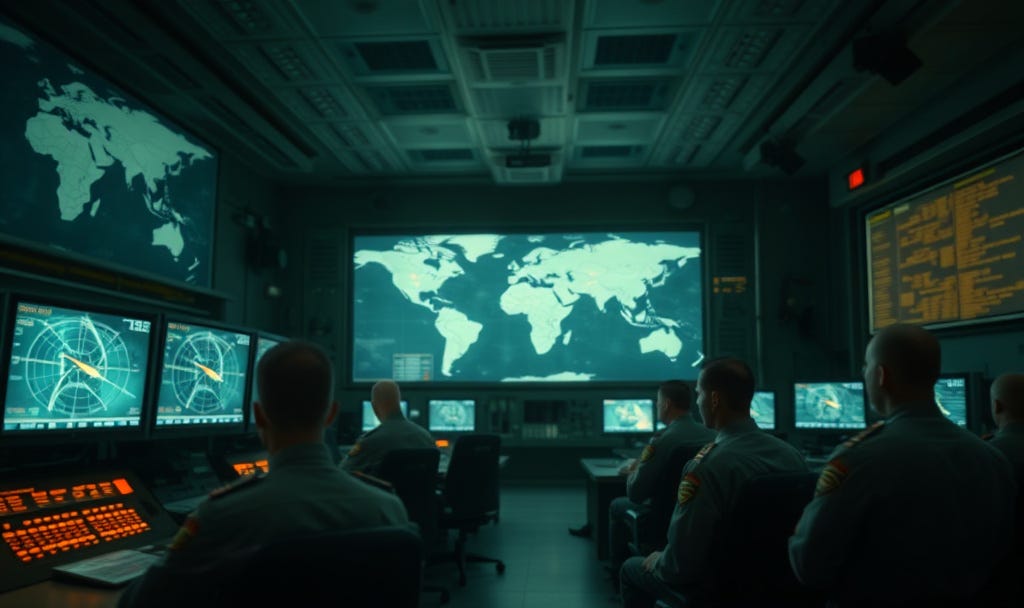
US defense strategy is converging around the China challenge with a level of clarity not seen since the Cold War. Precision strike investments are accelerating. Unmanned systems are transitioning from development to deployment. Force posture across the Indo-Pacific is being reshaped to support sustained strategic competition. The effort is deliberate, resourced, and institutionally coordinated, but the operational focus is misaligned with the nature of the conflict.
Offset thinking anchored in traditional warfighting domains cannot account for the terrain where strategic outcomes are already being shaped. Disruption requires domain awareness. Competitive advantage depends on recognizing where systems are being contested and how control is being exercised.
The Ghost of Doctrine Past
American military strategy has been shaped by three successive offset campaigns, each designed to maintain decisive advantage through technological and conceptual innovation. The first offset deployed nuclear deterrence to counter Soviet numerical superiority. The second offset combined precision-guided technology with maneuver concepts to neutralize Warsaw Pact mass. The third offset promised artificial intelligence, autonomous systems, and advanced intelligence capabilities to preserve overmatch against emerging peer competitors.
Each offset strategy assumed the enemy would fight in recognizable military domains. Nuclear deterrence worked because both sides understood escalation dynamics. Precision-guided munitions succeeded because they operated within established concepts of maneuver, firepower, and terrain control. Even the most advanced autonomous systems were designed to function within familiar frameworks of sensing, deciding, and acting across land, sea, air, space, and cyber domains.
But what if the war has already started, just not in the airspace you’re watching?
Oversight by Design
The Pentagon’s strategic fixation reveals a fundamental blind spot. While the Defense Department optimizes for a kinetic Taiwan scenario, Beijing is already exerting control in domains that don’t appear on any battle map. This is the terrain of what could be called the administrative domain, defined not by terrain or bandwidth, but by authority, standards, and control. Its actors are regulators, standards bodies, SOEs, and bureaucratic arms of party-state governance. Its tools include contracts, legal codes, licensing schemes, curriculum design, and platform rules. And its effects are cumulative: dependency, agenda-setting, and fait accompli legitimacy. War is actively being waged through administrative, legal, and narrative systems that generate strategic effects without triggering conventional defense responses.
Consider where Beijing is winning while Washington is planning. Chinese legal frameworks now structure port operations from Sri Lanka to Greece, creating dependencies that constrain partner nations during crises. Digital infrastructure exports from Huawei and other state-linked firms embed technical backdoors and legal authorities that affect cyber domain cooperation before any shooting starts. Elite co-option programs across Africa, Southeast Asia, and parts of Europe have created influence networks that shape policy decisions in Beijing’s favor. Governance export initiatives in fragile states are building administrative dependencies that determine alliance calculations and resource flows.
Cultural control narratives are perhaps the most insidious. Through systematic investment in media platforms, educational institutions, and cultural organizations, Beijing shapes how entire populations understand historical narratives, territorial disputes, and legitimate governance. This is not propaganda—it is infrastructure for perception management that operates at societal scale.
The absence of operational oversight mechanisms across these terrains should alarm anyone serious about strategic competition. We know how many missiles we have. We don’t know how many regulators China has trained. We track surface vessel movements but not port operating contract negotiations. We monitor military exercises but not standardization committee meetings. Offsetting only works if you can see the full map.
What the Pentagon Sees—And What It Misses
The misalignment between Pentagon assumptions and Beijing’s strategic reality becomes clear when examining how each side conceptualizes conflict itself. Pentagon doctrine assumes wars start with movement, escalate with firepower, and end with deterrence restored through successful defense or imposed costs. This framework shapes everything from force design to alliance planning to escalation management.
China operates from entirely different assumptions. From Beijing’s perspective, wars start with perception, escalate through administrative saturation, and end without formal conflict through established control. Where Pentagon planners see peace until shooting starts, Chinese strategists see continuous competition across systems of governance. American doctrine seeks to restore equilibrium through deterrence; Chinese planning imposes a new one through fait accompli governance.
This divergence explains why American briefings feel strong but outcomes feel weak. The United States designs military capabilities for scenarios where China deploys kinetic force against defended positions. China designs governance capabilities for scenarios where kinetic force is unnecessary because administrative control has already been established. We are offsetting kinetic risk while China is administering political control.
The strategic implications compound over time. Each successful governance intervention creates infrastructure for the next one. Port agreements enable debt-trap leverage. Debt arrangements enable political influence. Political influence enables regulatory capture. Regulatory capture enables economic dependencies. Economic dependencies enable strategic subordination. By the time military force becomes relevant, the battle for strategic autonomy has already been lost. Not every port concession or loan crystallizes into strategic subordination. But each one creates latent instruments Beijing can later activate, often without warning and without the need for overt escalation. The result is optionality: an expanding menu of leverage points that can be quietly scaled or held in reserve.
The Mirage of Preparation
Advanced military concepts currently under development demonstrate how even cutting-edge thinking can function like sophisticated sandbags around the wrong flood. Drone swarms will provide unprecedented tactical advantages in kinetic scenarios. Undersea warfare capabilities will complicate Chinese anti-access calculations. Multi-domain intelligence systems will enhance battlefield awareness across traditional domains. Kinetic deterrence and warfighting remain necessary, but they are no longer sufficient. When governance terrain is lost early, military contests are either pre-decided or no longer materialize at all. In that context, even the most sophisticated military innovations become tactically significant but strategically marginal to the competition actually underway.
The absence of any integrated civilian-military framework capable of contesting governance terrain abroad exposes the imagination gap at the center of American strategy. The Pentagon has allocated hundreds of billions of dollars toward military innovation while civilian agencies struggle to coordinate basic economic diplomacy. State Department budget requests get scrutinized while defense procurement moves through Congress with bipartisan support. USAID once operated development programs while Defense Department stabilization efforts worked at cross‑purposes in the same countries, and their dissolution has only deepened the coordination vacuum.
This is not about insufficient investment—it is about insufficient imagination. The bureaucratic architecture of American national security was designed for a world where military and civilian domains remained largely separate. Contemporary competition operates precisely in the integration spaces where maintaining that separation has become a liability. A sixth-generation fighter jet cannot contest a tax code, a zoning law, or a port operating contract. But those are the things winning the war.
Uncomfortable Truths
Several unsettling questions emerge from this analysis, questions that point toward uncomfortable truths about the nature of strategic competition and the adequacy of current American approaches.
What happens if the decisive phase of war is invisible to war planners? If strategic outcomes are determined through administrative processes that don’t register as military activity, then the most sophisticated defense establishment in history becomes strategically blind by design. Military intelligence can track every Chinese missile battery but cannot assess the political implications of standardization agreements or judicial cooperation treaties.
Who is designing the offset strategy for information environments, governance architectures, and administrative dependencies? The Pentagon has dedicated offices for every traditional domain of warfare but no equivalent structure for the administrative domain where China is achieving its most important strategic effects. Cyber Command addresses network security but not the broader information infrastructure that shapes political reality. Intelligence agencies collect information and retain covert action authorities, but they are structurally optimized for episodic influence, not for the sustained, overt governance shaping that Beijing practices as a core state function.
What if deterrence fails not because of weakness, but because it was aimed at the wrong problem? American deterrence strategy assumes China will pursue its objectives through recognizable military action that triggers predictable response scenarios. If China achieves those same objectives through governance interventions that never trigger deterrence thresholds, then the entire theoretical framework becomes strategically irrelevant.
To be clear, US strategic documents increasingly reference concepts such as ‘integrated deterrence,’ ‘whole-of-government competition,’ and ‘economic statecraft.’ But these ideas remain overwhelmingly kinetic-centric in practice. Governance terrain is treated as an adjunct to competition, not as the decisive arena where outcomes are being pre-arranged. There are no comfortable answers, only structural indictments. They suggest that the institutional system designed to provide national security may be systematically configured to miss the most important competition of our time. Offsetting without oversight is a kind of strategic hallucination. It feels like planning, but it’s actually drift.
No directorate exists with planning authority over governance competition. No institutional framework coordinates legal assistance, digital infrastructure, education, and standards-setting as mission-based functions. If offset strategy is to remain credible, it must eventually extend into the administrative domain with the same seriousness currently reserved for airspace, seabeds, and orbits.
Cold Clarity
The evidence suggests we are building tomorrow’s deterrent against yesterday’s war while Beijing writes the administrative code for the next decade’s reality. This is not a failure of resources or commitment—it’s a failure of strategic imagination about how power actually works in the twenty-first century.
We offset technical risk while China offsets political gravity. One of these forces shapes the environment where the other operates. Guess which one we’re not tracking. Until governance competition is treated as a mission to be planned and resourced—not a talking point—the United States will continue to offset against a threat vector Beijing has little incentive to use.