


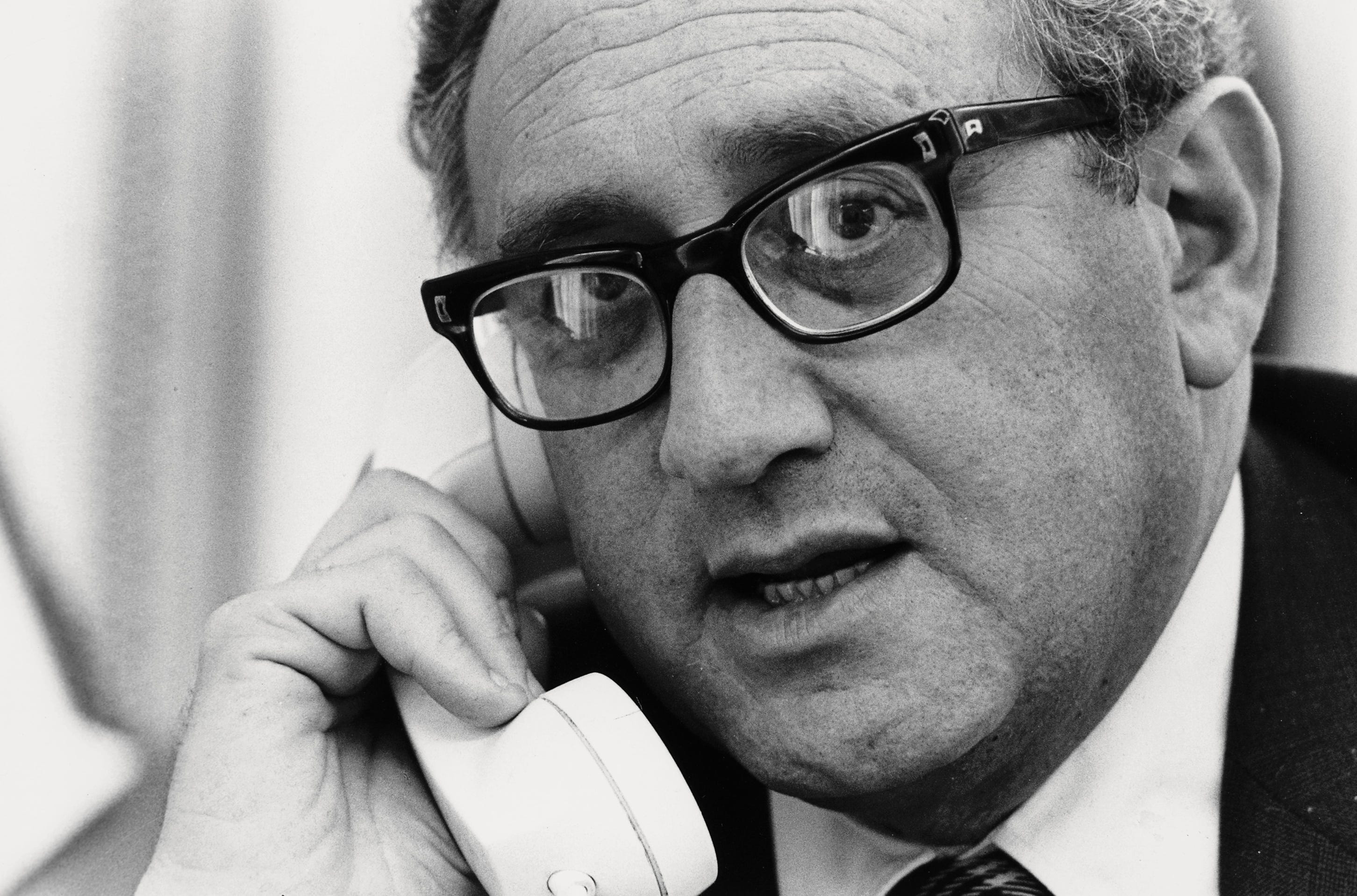

Henry Kissinger spent his life studying order. For him, power was not noise. It was architecture. Stability emerged when major states recognized one another’s interests and constrained themselves within an equilibrium. War was not inevitable; disorder was the result of miscalculation or revolutionary ambition. The task of statecraft was to prevent either from overwhelming the system.
For half a century, this framework helped shape American foreign policy. It trained generations of policymakers to think in terms of balance, deterrence, signaling, and diplomatic restraint. It assumed that sovereign states were coherent actors, that legitimacy moved slowly, and that power was exercised across borders rather than inside institutions. That lens was not naïve. It worked, within its historical conditions. But it contained a hidden assumption: that competition happens between states whose internal political architectures remain fundamentally intact. The 21st century has exposed the limits of that assumption.
The Hidden Premise of Balance
Balance-of-power thinking rests on three structural premises. First, that states are internally coherent — they may disagree, compete, or even fight, but their governing systems are presumed stable enough to function as negotiating entities. Second, that power is observable and external: military deployments, alliance commitments, economic leverage, sanctions — visible instruments that can be signaled and counter-signaled. Third, that legitimacy is largely domestic. States may seek influence abroad, but the core of political authority is generated and maintained internally.
Under these conditions, equilibrium is possible. Deterrence works. Escalation can be managed. Even adversaries can coexist within a structured order. The model breaks down when power operates differently — when it is exercised through the manipulation of administrative systems, legal regimes, institutional procedures, and narrative legitimacy inside other states. At that point, competition begins to operate at the level of institutional design.
The Category Error
Much of the Western debate about China over the past two decades revolved around familiar questions: Is Beijing revisionist? Can economic integration moderate its behavior? Will leadership turnover change incentives? Can deterrence by cost shift strategic calculations? These were not unserious questions. They were framed within a 20th-century logic — and they contained a category error.
China was not contesting policy preferences within an existing order. It was governing the competition itself. Beijing’s strategy did not depend on overt territorial conquest or direct military escalation, nor did it rely solely on ideological export. Instead, it treated institutions, procedures, standards, and legitimacy as instruments of long-term competition — embedding influence through elite networks, infrastructure dependencies, and international rule-making bodies. This was not a deviation from the system that could be corrected through sharper signaling or higher costs. It was a different operating logic.
Balance-of-power thinking presumes that rivalry can be stabilized because it unfolds at the level of visible capabilities and declared interests. But when influence is embedded administratively, the terrain shifts. The competition becomes persistent, cumulative, and difficult to isolate. Deterrence doesn’t disappear, but it does become insufficient.
Debates about alliance geometry, force posture, and burden sharing then begin to address symptoms rather than structure. By the time policymakers argue about perimeter lines or credibility, much of the competitive environment has already been shaped through quieter forms of institutional embedding.
Why Being Right Was Not Enough
Those often described as “China hawks” were correct about one central point: the challenge was systemic and durable, not a passing dispute over trade balances or diplomatic rhetoric. Where that camp struggled was in explanation and tool selection. If the threat is ideological expansion, the response is containment. If it is military aggression, the response is deterrence. If it is unfair trade, the response is economic correction. But if competition is embedded in governance — if it operates through institutional design and administrative integration — then the available tools look misaligned.
This was not a failure of vigilance. It was a mismatch between framework and phenomenon. The assumption that behavior would self-correct through economic liberalization underestimated the durability of a system capable of using openness instrumentally. The expectation that leadership turnover might soften strategic posture misunderstood the structural incentives embedded in long-term planning cycles. The belief that cost imposition alone could compel recalibration misread the cumulative nature of the competition. This was not a phase. It was a mode of operating that traditional statecraft could not register. As a result, policy oscillated between overconfidence in integration and renewed emphasis on deterrence, without fully accounting for how administrative leverage was narrowing strategic options in advance of an overt crisis.
The Blind Spot of Equilibrium
It would be a mistake to portray Kissinger as incapable of understanding structural change. Contemporary realists have attempted to adapt balance-of-power thinking to a world of economic interdependence and institutional density. Yet even these adaptations tend to treat institutions as arenas of competition rather than as instruments through which competition is embedded.
Kissinger was acutely aware that legitimacy and order evolve, and he understood that revolutionary powers reshape systems rather than merely contesting them. What he could not have fully anticipated was the degree to which administrative interdependence would become the primary medium of competition. His framework assumed that states could be balanced because their governing cores were distinct and negotiable. The emerging environment revealed something more complicated: competition was being conducted through the very mechanisms that make cooperation possible.
Kissinger’s realism emerged in a world defined by military blocs, nuclear deterrence, and ideological polarity — an environment in which equilibrium was a stabilizing necessity because escalation carried existential risk. The post-Cold War era appeared to confirm this logic. Economic integration deepened, institutions expanded, and globalization knitted systems together. Less visible was the extent to which integration could be leveraged administratively. Standards bodies, financial flows, academic exchanges, and infrastructure investments became channels of influence. Sovereignty remained formally intact, but decision-making environments subtly shifted.
Balance-of-power theory assumes that sovereign units negotiate across boundaries. Administrative competition blurs those boundaries. Policy debates begin to incorporate external preferences. Regulatory decisions reflect network dependencies. Political narratives adjust to reflect new constraints. Over time, what once appeared external becomes embedded — not through dramatic confrontation, but through the steady integration of structural advantage. This kind of competition rarely announces itself with troop movements or public crises. Equilibrium becomes difficult to achieve because the contest is no longer confined to visible instruments of statecraft. This does not invalidate realism. It reveals its limits.
The Implication Washington Still Hesitates to Face
If competition is being conducted administratively, then equilibrium cannot be restored solely through force or negotiation, nor can it be corrected by assuming that economic growth or leadership turnover will normalize behavior. The challenge is not episodic aggression. It is systemic embedding, and it requires a different vocabulary for power.
Policymakers reach for familiar tools — sanctions, military posturing, diplomatic signaling — while the underlying architecture continues to shift. Debates about retrenchment, posture adjustment, or renewed forward defense unfold within this inherited vocabulary. The sense of being perpetually reactive is not simply operational failure. It is conceptual lag. American strategy developed without language for power exercised through governance. The world Kissinger analyzed was structured by visible balances. The world now emerging is structured by embedded influence.
The question is no longer whether equilibrium can be restored through better signaling or tighter alliances, but whether strategy can recognize competition operating inside the administrative systems it once assumed were neutral terrain.
And architecture, once inherited, shapes what its occupants are able to see.