

Lebanon's Architecture of Dependence
What Happens When a Parallel State Is Dismantled but Not Replaced

In October 2024, Israeli aircraft bombed a chain of small lending branches across Lebanon. These were not barracks, launch sites, or command bunkers, but a non-profit that issued collateralized microloans to families against gold and savings. In the hours afterward, people across Lebanon scrambled to locate the branch lists, because the targets indicated where the next strikes might fall and whether they should leave. The institution was al-Qard al-Hassan, and to most observers, bombing it looked like an odd, almost incidental footnote to a war against a militia.
It was neither odd nor incidental. It was the clearest statement of the war’s actual object that Israel made.
Hezbollah is conventionally understood in two ways: as a security threat, a militia with a missile arsenal, or as a sectarian political party that holds seats in parliament and ministries in the cabinet. Both views are accurate, and both miss the structurally decisive fact. Over four decades, Hezbollah built the most fully realized parallel state operating inside a sovereign state it does not control: hospitals, schools, clinics, courts, a lending system, a reconstruction agency, and a welfare apparatus that reached most of a population the Lebanese state had stopped serving. In the territory it governs, Hezbollah does not supplement the state; it replaces it in practice. The legal state remains on paper, but the movement delivers the services and structures the day. Bombing a microloan charity is difficult to explain as counterterrorism. It is straightforward to understand as an attack on the system through which an adversary governs.
The point is not to romanticize Hezbollah’s system or mistake dependence for consent. The question is what the system did, who relied on it, and what happened when it was stripped away. In other theaters, armed movements have begun to build governance in the spaces weak states leave behind. Lebanon shows the process at maturity: a parallel state fully built, deeply depended upon, and now being taken apart.
The Hollow State
Hezbollah’s rise as a governing system begins with the condition of the Lebanese state itself. In Lebanon, state failure became a condition people had to organize their lives around. The 2019 banking crisis froze depositors out of their own savings and vaporized the currency. The 2020 Beirut port explosion destroyed a section of the capital along with what remained of public confidence. A financially crippled state could no longer reliably pay its public-sector salaries or keep its own hospitals and schools running, and leaned increasingly on Gulf and multilateral money to keep basic functions afloat.
Hezbollah’s system predated the collapse. The Islamic Health Organization was founded in 1984 to serve communities neglected by the state, and over time that same logic expanded into schools, courts, finance, welfare, and reconstruction. The collapse converted a parallel option into the only option. Its health network now operates on the order of ninety facilities, including eight hospitals, with care free or subsidized for a population the formal system had priced out or abandoned. The al-Mahdi and al-Mustafa school networks educate tens of thousands of students; the affiliated youth movement, with membership in the tens of thousands, sits inside the national scouting federation. Hezbollah-linked religious courts and arbitration bodies resolve civil and financial disputes within its communities. A reconstruction agency rebuilds what wars destroy.
This is the first thing that distinguishes Lebanon from other cases. In the Sahel, governance was still nascent. In Lebanon, it is mature, comprehensive, and, crucially, fused with the state rather than hiding from it. Its schools operate within Lebanon’s education system, its scouts belong to the national federation, and its political bloc and allies have held seats in cabinet. This is not a shadow state evading the official one. It is a parallel state threaded through it, drawing legitimacy from inside the same institutions it has rendered hollow.
The electoral record states the point precisely. In 2022, Hezbollah’s broader coalition lost its parliamentary majority, and the Shia seats stayed locked: Hezbollah and Amal, the older Shia party that forms the other half of the “Shiite duo,” held every one allocated to their community. The coalition eroded around Hezbollah and Amal; their base did not. That is what dependence looks like in electoral form. An actor does not need to win the country; it needs only to hold the territory it governs, and Hezbollah does.
The Bank of Last Resort
Of all Hezbollah’s institutions, one carries more structural weight than the rest. Al-Qard al-Hassan is the largest non-banking lender in the country; by its own leadership’s account it had issued some $3.7 billion in loans to 1.8 million people. It made small loans against collateral, gold, and savings to families the formal banks would not touch.
Then the formal banks defaulted on their own depositors. After 2019, when the national banking sector broke its commitments to the people who had trusted it, al-Qard al-Hassan did not. For a growing share of the population, an armed movement’s lending charity became the only working financial institution in Lebanon. The formal banking system had failed; the parallel one had not.
This is why the October 2024 strikes are the analytical key to the whole war. An outside reading called them an escalation against Hezbollah’s finances. The United Nations special rapporteur on counterterrorism observed that bombing the institution erased the distinction between civilian and military objects. Stripped of legal vocabulary, the underlying logic was plain: Israel was treating a financial institution as operationally decisive because, on the ground it was fighting over, finance was not adjacent to governance. It was governance. The branches were not where the weapons were. They were where the system touched ordinary life.
Damage, Not Transfer
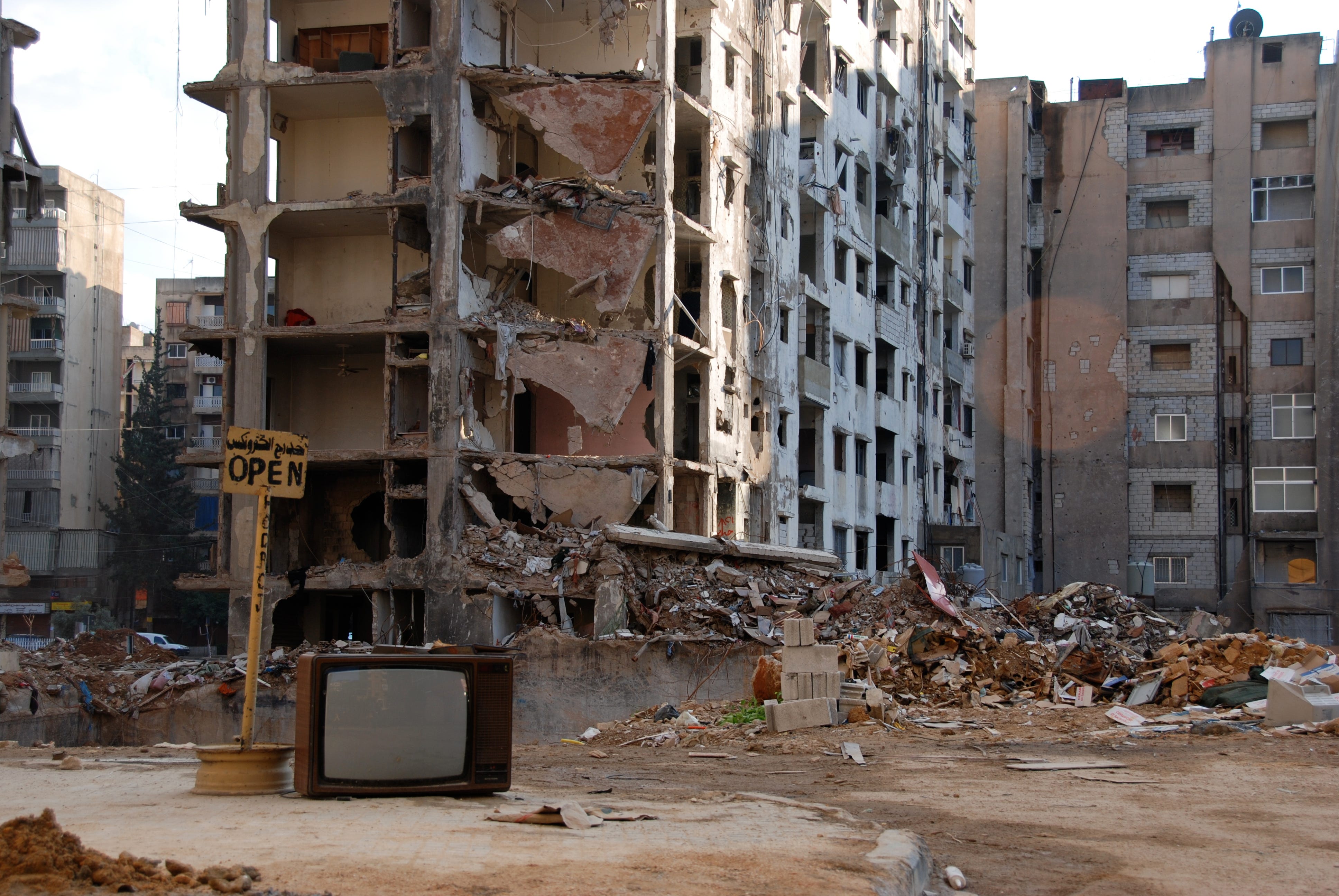
In September 2024, Israel escalated to full war, killing thousands and wounding many times that number, and killing the movement’s secretary-general, Hassan Nasrallah, on September 27. A ground invasion followed; a ceasefire arrived in November. By every conventional measure, Hezbollah had been badly damaged: its leader dead, its institutions struck, its strongholds flattened.
What happened next is harder to explain if Hezbollah is understood only as a militia. The system continued to govern. Within weeks, Hezbollah was distributing cash, financed largely by Iran: payments on the order of several hundred dollars per person to hundreds of thousands of registered families, with larger sums for destroyed homes and a year’s rent. Its reconstruction agency surveyed the overwhelming majority of damaged houses while the state did nothing; its director’s framing captured the entire posture in a sentence: they were not waiting for the government. A year on, the movement was still paying fighters’ salaries and martyrs’ stipends and operating, by one US estimate, on roughly sixty million dollars a month. It remained one of the largest employers in the country.
The strikes weakened Hezbollah’s system. They did not deliver the population to the state, because the state had been absent before the war and remained absent after it. The same institutions kept serving the same people, only wounded.
Six months after the ceasefire, the population was asked, in effect, to register where it stood. Municipal elections in the south, held after the decapitation, after the pager attacks, and after the bombing of the institutions, returned Hezbollah and its ally to control of the south, with many municipalities uncontested and no dramatic erosion of the base. At the moment Hezbollah’s system was most damaged, its hold over the south still did not break.
That result should not be mistaken for uncomplicated consent. The electoral field was shaped by the same system that delivered services, allocated favors, organized reconstruction, and made rival politics difficult to sustain. Confessional law reserved the seats; patronage networks ran through the institutions people depended on; and social entrenchment made a serious challenge, in the words of one analyst who tried it, “wishful thinking.” The vote did not prove affection. It revealed dependence. And that dependence survived the destruction of the system itself, which meant the population had not become available to be governed by anyone else.
The Vacancy Held Open
A technocratic government took office in February 2025 under a reformist president and prime minister, promising to rebuild. The damage totaled roughly eleven billion dollars, and the new government pledged to bring Hezbollah’s weapons under state control. Reconstruction money existed in more than one form: Gulf promises, US-mediated investment packages, and, later, broader regional bargaining around Iran. But the central condition remained the same. Hezbollah’s weapons had to come under state authority before the state would receive the resources needed to rebuild the areas Hezbollah had long governed.
That condition created a trap. The Gulf states, with Washington as intermediary, made reconstruction financing effectively contingent on a credible plan to disarm Hezbollah. Hezbollah tied disarmament to Israeli withdrawal. Israel continued to hold positions in the south and to strike. Lebanon’s government was too broke to fund reconstruction itself; the external money depended on disarmament; disarmament was refused while Israeli troops remained on Lebanese ground; and the financing did not come. The state was left unable to perform the one function that might have weakened Hezbollah’s hold: rebuilding.
For a time the process moved. Through 2025, under American facilitation, the Lebanese army cleared the south. By US Central Command’s count, nearly ten thousand rockets and some four hundred missiles were removed over the year, and by January the first phase between the Litani and the border had been declared complete. It unlocked nothing. The money still required full disarmament, and full disarmament was the step Hezbollah would not take while Israel held Lebanese territory. Partial clearance bought no reconstruction. The state remained as broke as before.
The conditionality therefore became more than a delay. It became a source of pressure in its own right, using reconstruction money to pursue an outcome the military campaign had not produced. The pressure ran inward as well as outward. In May, Washington sanctioned nine people, including Lebanese army and intelligence officers, for impeding disarmament. The target was Hezbollah, but the pressure also fell on the Lebanese state’s own security apparatus. The effect, whatever the intent, was to keep the state from filling the space Hezbollah’s damaged system had occupied. The military campaign weakened that system; the financing conditions prevented anything else from replacing it. The vacancy was not being filled. It was being held open.
The Patron Strained
Hezbollah’s system survived the death of its leader and the bombing of its institutions because Iran kept paying. Through 2025, the reported sixty million dollars a month from Tehran kept the network alive even as its leaders, branches, and strongholds were hit.
In 2026 the strain reached the source of that financing. On February 28, a joint US-Israeli strike killed Iran’s supreme leader along with much of the senior command. The regime did not fall. Succession to Mojtaba Khamenei was swift and orderly, and authority consolidated in a wartime apparatus of Revolutionary Guard and security elites. Tehran stayed firmly in command, intact enough that within days Hezbollah re-entered the war, firing on Israel in solidarity with its patron and fighting with a still-substantial arsenal. The strike did not break Iran’s chain of command, but it changed the financial equation for every system Tehran was still trying to sustain. Iran emerged from two wars in a year with extensive damage at home and a leadership now committed to a nationalist‑technocratic bargain: defending the country and rebuilding it. The money that had underwritten Hezbollah’s parallel state now competes with Tehran’s own reconstruction needs and with an economic strategy built around extracting value from control of the Strait of Hormuz rather than waiting for lasting sanctions relief.
The renewed fighting has deepened the damage. Israel answered Hezbollah’s return with an offensive that has devastated the south, including renewed strikes on the lending branches that had begun to reopen. By late June, after another round of ceasefire and deconfliction talks, the pattern had not changed: thousands were dead, more than a million had been displaced, Israeli forces still held positions in the south, and each pause in the fighting remained vulnerable to the next violation.
Hezbollah is now under pressure from three directions at once: its leadership has been hit, its institutions have been bombed, and its patron is under strain. The first two pressures did not break the system. Iran remained organized after the death of its supreme leader, and Hezbollah kept fighting after the death of its secretary-general. Both cases show the limits of decapitation. These systems were not held together by one man.
The harder question is whether Hezbollah can still afford to govern. An organization can survive the killing of its leader and the bombing of its branches if the money keeps arriving to rebuild them. It cannot rebuild a parallel state on a patron’s budget already claimed at home, especially when the only other actor capable of providing those services, the Lebanese state, is still being denied the resources to do so.
The Deeper Vacancy
The prevailing view reads this as the long-awaited weakening of Hezbollah: a militia degraded, a patron strained, and an opening for the Lebanese state to reassert itself. That reading misses the deeper problem. Iran is not walking away from Hezbollah. It is treating the movement as strategic depth in a wider regional fight, even as Hezbollah’s governing system now has to compete with Iran’s own reconstruction needs for every dollar.
The pattern is familiar. When armed groups build systems that people rely on, destroying those systems without replacing them does not restore the state. It deepens the absence the state had already left behind. In the Sahel, armed groups were still building that kind of authority, and the populations around them had only begun to orient toward it. In Lebanon, the process was mature. Finance, health care, schooling, justice, reconstruction, and welfare had all been organized around Hezbollah’s institutions. Dismantling a system that people had barely begun to depend on creates one kind of vacuum. Dismantling one that has structured daily life for decades creates another.
That dependence is not moving toward the state. The vote keeps recording that fact, even as Hezbollah’s institutions are damaged. Weakening the system does not deliver these communities to the government. It strands them between a movement that can no longer reliably fund what it built and a state still unable to take its place.
Israel in Lebanon, like external actors in the Sahel, is using force against a governing system without managing what comes after it. That is the difference between damaging an adversary’s institutions and replacing the order people actually live inside.
For now, the balance sheet is simpler than the conventional account allows. The visible damage is to Hezbollah as a militia. The deeper damage is to the system that governed where the Lebanese state did not. For a time, Hezbollah filled the space the state had left behind. Dismantling that system without replacing it does not return the south to the state. It returns the south to the vacancy, only deeper than before.