


Over the past two decades, Gulf states have constructed institutional architectures designed to permit simultaneous participation in two competing governance systems. They operate inside an American security and financial order they cannot replace and a Chinese economic and technical order they cannot refuse. Their response has been to engineer the administrative terrain between the two: the contracts, technical standards, regulatory frameworks, and institutional memberships that determine what a state can be compelled to do and what it cannot.
The strategic decisions that matter in Riyadh and Abu Dhabi concern which legal system governs an energy sale, which vendor’s equipment occupies which layer of a telecommunications network, which data governance model anchors a national regulatory framework, and where two incompatible systems will be permitted to interface. These choices accumulate, and each one reshapes the institutional ground on which the next is made.
The prevailing analysis reads Gulf strategy at a different layer. A recent Foreign Affairs essay asked whether Saudi Arabia could keep hedging, and the question typifies a literature that treats Gulf positioning as a problem of alliance management: which coalitions to join, which patrons to favor, and how long a middle position can hold. The frame captures an important dimension of Gulf strategy, and the war gave it urgency. With the Strait of Hormuz closed since March and a ceasefire that left it closed, analysts spent the spring forecasting which way the Gulf would tip under sustained pressure.
That forecast reflects an analytical frame centered on alliance behavior rather than institutional design. The institutions were built so that alignment would become a less consequential question. The proper subject of analysis is therefore the institutions themselves.
Viewed through the institutions that govern energy, finance, and technology, Gulf behavior becomes considerably more coherent. Saudi Aramco sells crude through subsidiaries whose contracts run under English, Singaporean, and American law, while its upstream production remains governed entirely by Saudi concession. Abu Dhabi operates a financial center that applies English common law directly, under a chief justice drawn from the United Kingdom’s Supreme Court, while the same center maintains cooperation agreements with the People’s Bank of China and a framework agreement with the Shanghai Stock Exchange for a Belt and Road exchange. The pattern repeats across energy, finance, digital infrastructure, and trade governance.
Riyadh and Abu Dhabi share the same strategic challenge while pursuing different institutional responses. Saudi Arabia is building new institutions and regulatory structures. The United Arab Emirates is adapting and repositioning institutions it already possesses. The consequences of those choices become visible only under stress, but the comparison begins with the shared constraints both states faced. That shared foundation is the focus here.
Two Orders
The American order enters the Gulf through security commitments and operates through rules, procedures, and regulatory controls. The Strategic Defense Agreement that Washington and Riyadh signed in November 2025 designated Saudi Arabia a major non-NATO ally and opened a path to F-35 transfers, yet the substance of the relationship runs through procedure: interoperability requirements, end-use monitoring, and technology transfer rules that continue to govern American-origin systems long after acquisition. The International Traffic in Arms Regulations follow American equipment wherever it goes, constraining how it can be modified, maintained, and resold, and the friction is consequential enough that Riyadh’s defense localization authority has filled the resulting space with Turkish and South Korean partners. The financial layer reaches further still. Dollar clearing, correspondent banking relationships, and the extraterritorial reach of American secondary sanctions give Washington regulatory influence over transactions that never touch American soil. The newest layer governs computation itself: the Public Investment Fund’s artificial intelligence venture has announced plans to deploy hundreds of thousands of American GPUs, and every tranche of that deployment runs through licensing decisions made in Washington.
Each of these benefits arrives wrapped in obligations that someone else drafted. Participation in the American order means operating inside rulebooks written in Washington, enforced through mechanisms ranging from export control audits to entity list designations, and revisable without Gulf consent. The order delivers security and market access at the price of compliance with rules written elsewhere.
The Chinese order enters through commerce and embeds through infrastructure. It embeds through duration rather than formal alliance commitments. Huawei equipment occupies the radio access, core, transport, and network management layers of telecommunications systems in both Saudi Arabia and the UAE, and industry estimates put the replacement timeline for integrated deployments of this depth at nearly a decade. The UAE launched the world’s first commercial upper 6 gigahertz network with Huawei this April. COSCO Shipping Ports holds a thirty-five year concession over a container terminal at Khalifa Port. Chinese contractors built tunnels, towers, and worker housing at NEOM, and Chinese banks participated in the syndicated financing of Emirati port infrastructure. Bilateral trade between China and the UAE alone exceeded one hundred billion dollars in 2024. None of these arrangements carries a security guarantee, and that absence is part of the design. Equipment contracts imply maintenance relationships, upgrade paths, spare parts pipelines, and technical standards that shape interoperability for decades. The dependencies accumulate quietly, transaction by transaction, and they are denominated in switching costs rather than treaty obligations.
The two orders impose increasingly incompatible requirements. The American system increasingly demands exclusivity in domains it defines as sensitive: when Abu Dhabi’s flagship artificial intelligence firm sought American chips and Microsoft capital, the price was divestment of its Chinese hardware and partnerships, a transaction completed under explicit American supervision. The Chinese system assumes its infrastructure will remain embedded through whatever political weather arrives. A state participating in both therefore lives with a standing contradiction: one order’s compliance regime treats the other’s installed base as a violation.
Exit from either order would resolve the contradiction at a cost neither Riyadh nor Abu Dhabi will pay. American security architecture has no available substitute, a fact the spring’s war demonstrated rather than diminished. Chinese demand, Chinese construction capacity, and Chinese technology pricing have no readily available substitutes at comparable scale. The constraint environment is therefore durable on any relevant planning horizon. The strategic question is where each order's authority begins, where it ends, and who controls the boundary. The institutional record of the past two decades shows Riyadh and Abu Dhabi answering that question with far greater precision than the vocabulary of hedging implies. The institutional logic becomes clearest where the stakes are highest, beginning with how the Gulf sells its oil.
The Practice
Saudi Aramco distributes every transaction across several legal systems, and each system touches only a fragment. Upstream production operates under Saudi concession and Saudi law, beyond the reach of any foreign court. Sales run through regional trading entities chosen for their jurisdiction: Aramco Trading Americas contracts under American law for liquefied natural gas sourced from Texas and Louisiana, a Singapore entity serves Asian buyers, and an English-law entity covers Europe and Africa. Capital markets instruments are governed by English law with disputes routed to arbitration in London. Even the pricing layer follows the pattern. Aramco sets its official selling prices unilaterally each month and indexes them to a different benchmark in each region: Oman futures and Dubai assessments for Asia, Brent for Europe, the Argus sour crude index for North America. The company has organized its commercial architecture so that production sovereignty remains entirely at home while commercial enforceability is exported, piece by piece, to whichever forum its counterparties trust.
The Abu Dhabi National Oil Company has formalized the same bifurcation in its published terms. Its general conditions for crude sales specify English law and arbitration before the International Chamber of Commerce, with the seat at the company’s option in London, Paris, or Geneva. Its upstream concessions operate under Abu Dhabi law, with disputes seated in Abu Dhabi under rules whose default venue is the Abu Dhabi Global Market, the common-law jurisdiction the emirate constructed inside its own borders. Disputes that stay home are therefore still resolved in an English-law enclave, one the Emirate owns. The architecture treats both orders identically: the China National Petroleum Corporation holds stakes in the same concession instruments as BP, TotalEnergies, and Inpex, under the same law, the same fiscal regime, and the same oversight. Uniformity at the contract layer is what preserves optionality at the strategic layer.
Digital infrastructure shows the same distribution executed vertically rather than geographically. NEOM’s cloud and computation layer is American: Oracle anchors its hyperscale data center, NVIDIA supplies its processors, and its privacy compliance runs on American software against a data protection law modeled on European regulation. Its physical layer is substantially Chinese: Huawei implemented the project’s first data center and supplies networking equipment, and a joint venture with Dahua manufactures the surveillance systems. Each vendor occupies a defined stratum, and control resides at the interfaces between strata. The arrangement allows American software to run above Chinese hardware indefinitely, because the boundary between them is a design feature maintained by the host rather than a contradiction awaiting resolution.
Saudi data governance regulates that boundary directly. The Personal Data Protection Law borrows its rights architecture from Brussels, with lawful bases, impact assessments, and breach notification familiar to any European compliance officer, and borrows its sovereignty mechanics from Beijing, with residency expectations and a national security override that lets the regulator halt any cross-border transfer immediately. The synthesis serves Riyadh: data moves when the state permits and stops when the state decides, and the regulator issued forty-eight enforcement decisions in its first year to demonstrate that the discretion is real. The statute determines which information moves between jurisdictions and under whose authority.
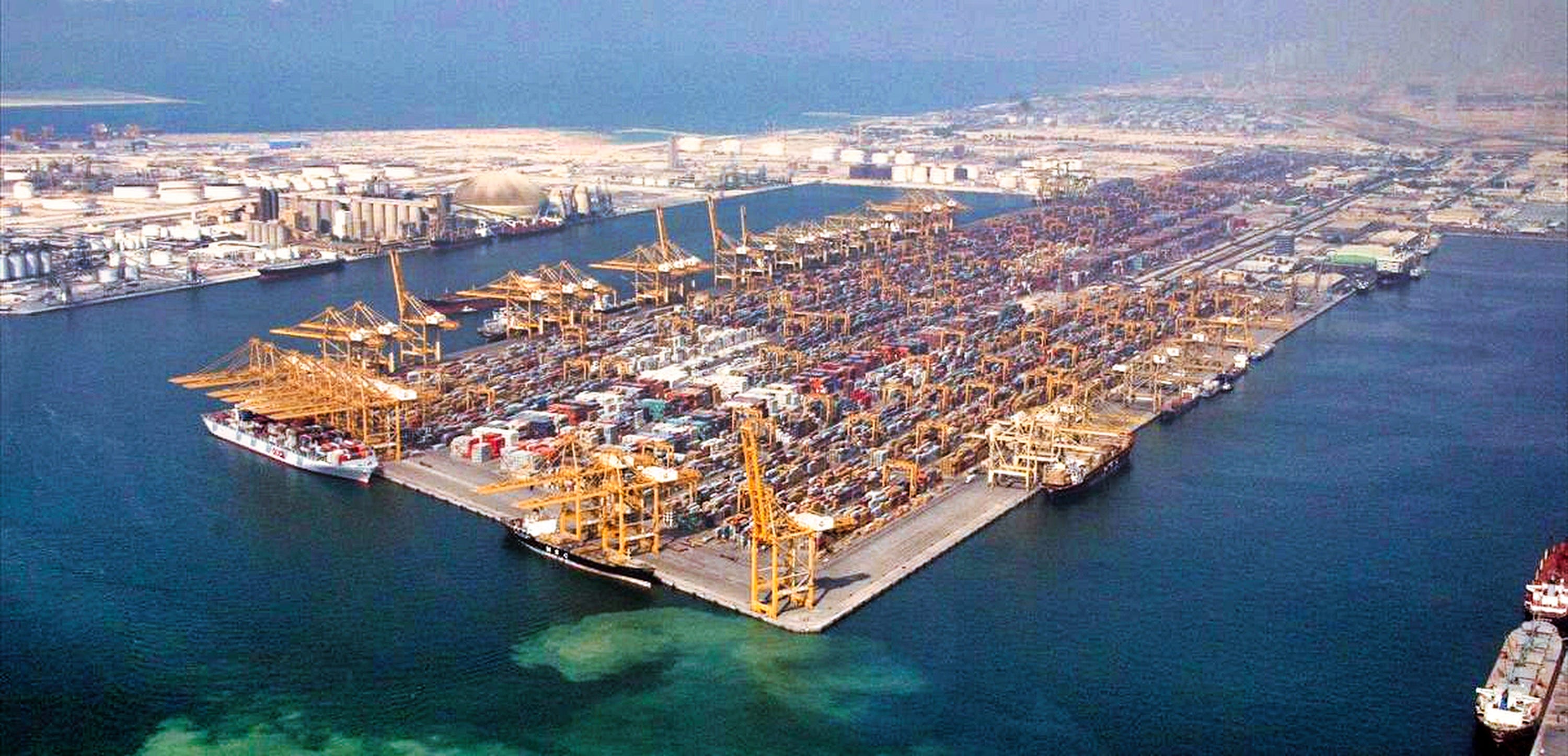
Trade architecture completes the picture. DP World is incorporated under the common law of the Dubai International Financial Centre and operates its home port under UAE civil law. It administers the Jebel Ali Free Zone under regulations of its own, and federal export controls layer over all of it. A container moving through Jebel Ali can pass through a customs-bonded zone where goods enter duty free, sit for two years, and re-export without ever triggering a tariff. The port handled 15.5 million containers in 2024. Washington stations an export control officer at its Dubai consulate to police that flow, and the Commerce Department has added Emirati trading firms to its entity list for routing controlled goods onward to Iran and Russia. The free zone is the physical location where American and Chinese trade governance overlap, and the UAE has arranged matters so that each order polices its own writ while the Emirates controls the ground both stand on. The surrounding treaty network reinforces the position: the UAE’s economic partnership agreements, thirty-six concluded and seventeen in force after the Korea agreement took effect in May, link it bilaterally to European-aligned, American-allied, Southeast Asian, and Eurasian customs regimes at once.
The same logic now extends to the bodies that write the rules themselves. Saudi Arabia holds one of fifteen national seats on the Technical Management Board that directs the work of the International Organization for Standardization, chairs the advisory group of the United Nations telecommunication standardization sector, and sits as a full member of the financial action task force, the Basel Committee, and the Financial Stability Board. The UAE chairs the regional committee of the international securities regulators’ organization and hosts the International Renewable Energy Agency in Abu Dhabi. A seat at this layer operates upstream of every choice documented above: the body that decides which standards exist has already shaped the menu from which every adopting state will choose. Participation in rule-writing shapes the choices available to every state that adopts the resulting standards.
Taken together, the contracts, the stacks, the statutes, the zones, and the seats describe a consistent approach. Dependencies are separated so that pressure in one domain does not automatically spread to another. Authority is distributed across multiple jurisdictions. Critical functions retain alternative pathways. The points where the two orders meet remain governed by the host. The result is the position the spring’s forecasts could not see: participation in two governance systems without capture by either.
The Test
The war supplied the pressure, and on April 28 the United Arab Emirates supplied the demonstration. The Emirates announced its withdrawal from OPEC and the wider OPEC+ alliance effective May 1, ending a membership that began in 1967. The decision was made alone; Riyadh learned of it with everyone else. Commentary processed the exit as an oil story and a unity story: production would rise, the cartel would weaken, the Gulf had fractured. The exit was more than an oil market decision. It was an institutional decision. OPEC functions as a governance system in which quotas allocate production, joint committees monitor compliance, and ministerial meetings bind members across political cycles. For years that system held Emirati output below the capacity Abu Dhabi had built, limiting the state’s ability to deploy infrastructure it already possessed. The Emirates spent two decades engineering terrain it controlled and then exited terrain it could not.
The exit also closed an interface. OPEC+ bound the Emirates into standing coordination with Russia, a sanctioned producer, and into institutional adjacency with Iran through the alliance’s permanent machinery. Membership carried administrative obligations of the kind the earlier sections traced through contracts and networks: joint production decisions, shared monitoring, and coordinated output cuts executed through the alliance’s committees, conducted alongside states under American and European sanction. Whatever weight that consideration carried in Abu Dhabi’s decision, the practical consequence is clear: a governance connection between the Emirati state and sanctioned actors existed in April and was gone in May. The pattern documented across contracts, networks, and free zones repeated at the scale of an international institution. Within weeks the national oil company announced an acceleration of as much as fifty-five billion dollars in contracting, the freed capacity converting directly into deployment.
Riyadh’s response was silence, and the silence was instructive. Saudi Arabia designed the modern production coordination framework, supplies its administrative center of gravity, and uses it as an instrument of fiscal and strategic management. The kingdom sits at the center of the system. The two states faced the same institution under the same pressure and moved in opposite directions: one deepened its hold on a system it runs, the other departed a system it could never run. Each move was rational, and each followed from the terrain the state had spent decades building.
The episode compressed twenty years of institutional construction into a single month of visible motion. When sustained pressure arrived, the moves that mattered were administrative: a membership ended, a quota dissolved, a contracting program accelerated, and a coordination interface closed. The institutional arrangements built over two decades shaped the range of choices available once pressure arrived. Saudi Arabia had spent the decade constructing new institutional ground. The Emirates had spent the same period repositioning ground it already held. The forecasts that asked which side the Gulf would choose were watching for a decision that years of institutional design had already rendered less consequential. The decisions that mattered had been made over twenty years, in contract clauses, committee seats, licensing regimes, and institutional exits. They produced two states that share a design logic and hold different ground. The next test will find them as this one did: holding terrain rather than choosing sides.
A later analysis tackles the divergence: If Saudi Arabia and the UAE share the same institutional logic, why are they producing increasingly different outcomes? The answer lies in how each state has chosen to build and deploy the institutions described here.