


Editor's note: I published a new piece in Small Wars Journal last week titled Administrative Terrain and the Operational Role of SOF in Modern Irregular Warfare, which applies the governance warfare framework to SOF's operational environment and the administrative failures that break JADO integration before anyone fires a shot. It pairs directly with the force design argument below. Operators and planners will find it useful.
Military organizations have not ignored irregular warfare. Over the past two decades, they’ve incorporated it into planning, expanded special operations capabilities, and integrated non-kinetic tools into campaign design. These efforts addressed the forms of competition most visible within available frameworks.
What they did not change was how the battlespace itself is defined.
The categories used to organize military thinking about conflict were not designed to register where decisive effects are now being produced. That is the problem. Not emphasis or institutional preference. Not the familiar claim that irregular warfare has been undervalued. The problem is taxonomic.
As a result, irregular warfare has remained persistently adjacent to force design rather than structuring it. Recognized as important but not decisive. Integrated into planning but not foundational to how campaigns are structured. The pattern is more consistent than explanations of emphasis or prioritization allow.
Why Irregular Warfare Remained Adjacent
Irregular warfare did not remain marginal because it was ignored. It remained marginal because it fit cleanly into categories that structurally excluded it from force design.
Within conventional planning frameworks, irregular warfare has typically been located in one of three ways. It is treated as a specialized mission set, associated with particular units and skill sets. It is treated as a phase of operations, occurring before or after large-scale combat. Or it is treated as a supporting activity, shaping conditions for decisive action elsewhere. Each of these placements allows irregular warfare to be integrated into planning without requiring changes to how the decisive battlespace is defined.
This placement is internally coherent. It preserves a stable distinction between activities that structure campaigns and those that support them. It also aligns with how military organizations allocate responsibility, resources, and authority.
What it does not do is register competition that operates on the systems that define the battlespace rather than within the battlespace itself.
As a result, irregular warfare appears consistently important but persistently non-structuring. It is incorporated into plans, but it does not reorganize them.
Why the Decisive Looks Diffuse
A second constraint follows from how irregular warfare has been operationally described.
Conventional force design is organized around systems that concentrate and apply power: logistics networks, command-and-control architectures, force posture, industrial capacity, and the legal authorities that enable their use. These systems provide planners with identifiable centers of gravity and recognizable pathways to decisive effect.
Irregular warfare, as traditionally framed, does not appear to operate on those systems directly. Its components—populations, narratives, proxies, influence, local legitimacy—are diffuse. They do not resolve at a definable point. They do not map cleanly onto systems of deployment, sustainment, or command. They do not produce outcomes that can be sequenced or concluded.
This reinforces the perception that irregular warfare lacks a center of gravity. The perception is wrong. The center of gravity exists. It is the institutional infrastructure—rules, standards, authorities, procurement systems, legal frameworks—that structures access, determines interoperability, and defines what options are available before any operational decision is made. This infrastructure is not diffuse. It is distributed across governance systems rather than concentrated in a targetable node. The conventional planning model, calibrated to recognize centers of gravity that present as concentrated and strikable, cannot register a center of gravity that presents as procedural and accumulated.
Because the center of gravity does not look like one, everything that operates near it gets classified as supporting activity. The locus of decision is misidentified as the periphery of decision.
Where Decisive Effects Are Actually Produced
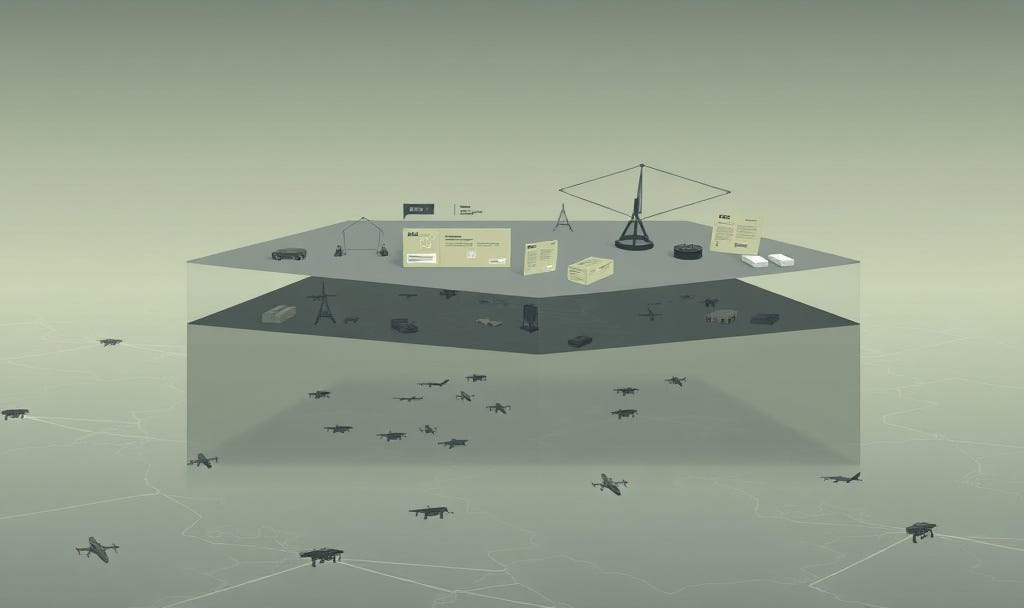
Across multiple domains, strategic outcomes are increasingly being shaped not through the application of force within a defined battlespace, but through changes to the systems that define what that battlespace is.
Technical standards determine which equipment interoperates with which networks, and therefore, which countries’ infrastructure a partner nation will embed for decades. Procurement rules and financing mechanisms structure supply chains in ways that generate dependency before any crisis reveals it. Regulatory frameworks condition access to infrastructure. Legal authorities define which actions are permissible, which actors are legitimate, and which options exist at all.
Consider one example. Maritime insurance coverage requirements determine which vessels can transit specific routes and which shipping corridors remain economically functional—a dynamic examined in recent work for the Irregular Warfare Initiative. When insurers withdraw coverage from a corridor, the economic viability of that corridor collapses regardless of whether physical access remains open. No interdiction occurs. No threshold is crossed. The mechanism operates through commercial governance—underwriting decisions, regulatory frameworks governing coverage obligations, reinsurance structures—and it applies pressure with built-in deniability because the decision presents as expert judgment rather than strategic intent. A state or coalition that can influence the risk assessment frameworks governing maritime coverage holds leverage over global shipping patterns that most force design models do not recognize as a military-relevant variable.
These systems do not sit outside competition. They determine how competition unfolds.
When these systems are configured in ways that constrain one actor’s options while expanding another’s, the resulting effects are not peripheral. They shape force availability, alliance behavior, escalation pathways, and the viability of military options before any operational decision is made.
From this perspective, the decisive phase of conflict does not begin when forces are deployed. It begins when the conditions that determine whether those forces can be used effectively are established.
Why the Existing Distinction Could Not Capture This
The irregular–conventional divide assumes that competition occurs within a battlespace that can be defined in advance. Activities are then categorized based on how they operate within that space: conventional if they concentrate force, irregular if they operate around it.
This assumption no longer holds.
When competition operates through the design and configuration of the systems that define access, authority, and decision pathways, the battlespace itself is not fixed. It is shaped over time, often through processes that appear administrative, technical, or economic rather than military.
Within this environment, the distinction between irregular and conventional becomes structurally inadequate. The question is no longer how force is applied within a given space, but how that space is structured before force is ever applied.
Frameworks built to categorize action within a fixed battlespace cannot register competition over the construction of that battlespace itself. What falls outside their categories does not appear decisive, even when it determines the outcome.
The Resulting Misalignment
This produces a structural misalignment between how force is designed and where outcomes are determined.
Planning systems optimize for responsiveness to events rather than for shifts in the systems that structure the operating environment. Metrics track activity, output, and capability, but not positional change within the systems that govern access and constraint. Assessment cycles capture snapshots of conditions that appear stable within any given period, while the cumulative shift in those conditions goes unrecognized.
The result is a pattern that appears as friction, delay, or strategic surprise. Effort accumulates. Capabilities expand. Engagement increases. But the environment within which those capabilities are intended to operate has already been shaped in ways that limit their effectiveness.
This is not a failure of execution. It is a mismatch between the level at which competition is being conducted and the level at which it is being observed.
Reclassifying the Decisive Phase
Once the environment is understood in these terms, the placement of irregular warfare within the existing framework becomes explicable as a category error rather than a value judgment.
Irregular warfare was never simply a set of supporting activities operating alongside conventional force. It was the closest available category for forms of competition that did not fit within the conventional model. It was a category of approximation. It captured aspects of what was happening, but not the mechanism through which outcomes were being determined.
The decisive phase of modern conflict is the phase in which the systems that structure access, authority, and decision space are configured. This phase has no doctrinal home. It is not irregular in the traditional sense. It is not conventional. It is the competition over the institutional architecture that determines whether force can be used effectively at all, and it is decided before the question of force arises.
The problem is not that irregular warfare was undervalued. It is that the framework used to interpret it was not designed to recognize the level at which it operates.
Strategic outcomes are increasingly determined by how the systems that structure competition are designed, configured, and positioned over time. These systems define what options are available, which actions are viable, and which outcomes are possible before any operational decision is made.
When the decisive phase of conflict occurs at this level, the distinction between irregular and conventional does not resolve the problem. It obscures it.
The question is not which form of warfare should take precedence. It is whether the categories used to organize military thinking can register where decisive effects are now being produced.
Until they can, force design will continue to optimize for a battlespace that has already been shaped elsewhere—and to arrive too late to change it.