

China This Week: Strategic Moves and Messaging
March 6 – March 12, 2026

A standing weekly operational intelligence brief tracking China’s governance-based competition.
Bottom Line: As the Two Sessions conclude and the 15th Five-Year Plan (15th FYP) framework solidifies, Beijing is simultaneously tightening domestic governance discipline, codifying identity policy in law, and advancing industrial strategy in emerging technologies. The system is shifting from strategic articulation to administrative activation, where the main moves occur through cadre discipline, law, implementation guidance, and carefully positioned diplomacy rather than new slogans.
1. China Codifies National Identity Engineering in New Ethnic Unity Law
China’s legislature approved a sweeping “ethnic unity” law expanding state responsibility for shaping a unified national identity. The law mandates Mandarin-language education, promotes mixed housing and migration policies among ethnic groups, and directs schools, families, and local governments to cultivate “correct views” of Chinese history, culture, and national identity.
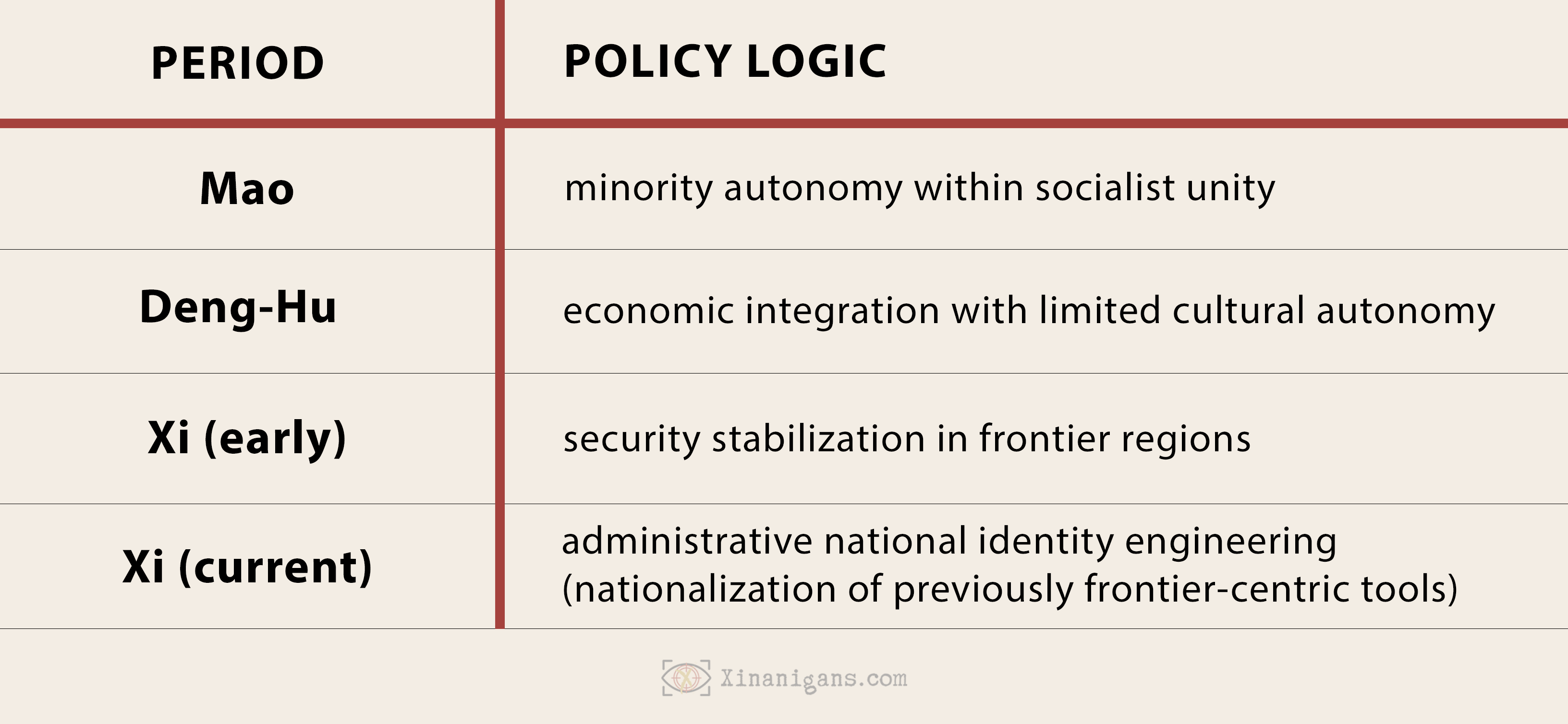
The law formalizes a policy shift under Xi Jinping that treats ethnic identity as a governance problem to be administratively managed rather than culturally negotiated. As I examined in earlier analysis of Xinjiang policy, Beijing has fused surveillance systems, legal frameworks, and education policy into a governance model designed to reshape identity itself, an approach now being codified into national law.
Evolution of China’s Ethnic Policy
Why it matters:
The law moves ethnic policy from frontier security management to national governance doctrine. Policies previously tested in Xinjiang and Tibet that combined surveillance governance, legal frameworks, and education policy are now being institutionalized across the administrative system. Identity formation is increasingly treated as a bureaucratic outcome rather than a cultural process.
Implications for US National Security:
Narrative Shielding: Codifying assimilation policies in national law strengthens Beijing’s ability to frame criticism as interference in domestic governance rather than human rights violations.
Model Export Signals: Analysts should watch whether similar identity-management frameworks appear in Belt and Road partner states or diaspora engagement strategies.
Collection Focus: Map where frontier-style identity management tools (e.g., Mandarin mandates, mixed housing directives, surveillance-backed education campaigns) appear in inland provinces as early indicators of national doctrine migration.
2. Politburo and Two Sessions Consolidate 15th FYP Direction
China’s leadership used the final phase of the Two Sessions to reinforce priorities for the 15th FYP, emphasizing technological self-reliance, industrial upgrading, and economic resilience amid a “more complex” international environment. Official messaging highlighted innovation capacity, advanced manufacturing, and coordination between central planning and provincial implementation.
Why it matters:
Five-year plans function as China’s primary coordination mechanism, aligning ministries, provincial governments, and state enterprises around national strategic priorities. The emphasis on resilience and innovation signals that the upcoming plan will deepen the state’s role in directing technological development and economic security.
Implications for US National Security:
Strategic Planning Continuity: US planners should expect a consistent multi-year runway of Chinese industrial and technology policy; the uncertainty lies in execution speed and sector emphasis rather than strategic direction.
Supply Chain Leverage Erosion: Sustained prioritization of resilience and technological self-sufficiency gradually erodes US leverage derived from Chinese dependence on foreign supply chains.
Monitoring Priority: Prioritize building collections on provincial implementation guidance and sectoral 15th FYP sub-plans, not just headline NDRC documents, to see where Beijing is actually betting capacity and tolerance for underperformance.
3. China Expands AI Governance and Industrial Strategy
Chinese officials outlined an expanded national strategy for artificial intelligence governance and development, emphasizing regulatory frameworks alongside industrial scaling. Policy discussions highlighted the integration of AI across manufacturing, public administration, and national security applications.
Why it matters:
Beijing is now treating AI as a core governance infrastructure, embedding it into manufacturing, public administration, and security systems under centralized coordination rather than leaving it as a standalone tech sector. This reflects a broader approach in which emerging technologies are synchronized with governance oversight from the outset, allowing the state to direct development rather than regulate it after the fact.
Implications for US National Security:
Synchronization Advantage: China’s state-directed AI ecosystem allows research, capital, and regulatory authority to move in parallel. US planners should expect faster system-wide deployment of AI-enabled capabilities once priority applications are identified.
Dual-Use Integration: Monitoring how AI research transitions into manufacturing, surveillance, and military applications will reveal the pace at which China converts technological capability into operational advantage.
Indicators to Track: Monitor AI regulatory sandbox pilots, procurement guidelines for AI in public administration, and PLA/People’s Armed Police doctrine or training updates referencing AI-enabled command, targeting, and logistics.
4. China Demonstrates Expanding Crisis Diplomacy Capacity
Beijing deployed a dual diplomatic track during the ongoing Middle East crisis. While Foreign Minister Wang Yi conducted leader-level phone diplomacy across multiple regional and international actors (Qatar, Pakistan, Kuwait, and Bahrain), China’s special envoy Zhai Jun carried out shuttle diplomacy in Gulf states including Saudi Arabia, the UAE, and with the GCC secretary-general.
Why it matters:
Crisis response is becoming a proving ground for China’s whole-of-system overseas governance, combining consular protection, logistics, and diplomatic engagement. Notably, Beijing’s outreach this week concentrated on Gulf monarchies and diplomatic intermediaries rather than security guarantors, positioning China inside the region’s mediation architecture while avoiding direct military commitments.
Implications for US National Security:
Evacuation Logistics as Readiness Signal: Embassy coordination and transport arrangements during evacuations provide observable indicators of China’s ability to protect overseas citizens and sustain crisis operations abroad.
Readiness Indicators: Track the balance between commercial charters, PLA/Navy lift, and pre-positioned transport contracts in evacuations as a proxy for expeditionary logistics maturity and civil–military coordination.
Irregular Warfare Spotlight
No separate spotlight this week. Beijing appears to be in an administrative activation phase prioritizing bureaucratic alignment, policy codification, and institutional preparation over external signaling. During such phases, the most revealing indicators shift away from diplomatic messaging toward provincial execution, regulatory change, and early implementation signals.
Chinese Vulnerabilities & US Counter-Opportunities
This week’s signals reflect a governance system moving from strategic planning to administrative activation. As FYP priorities translate into bureaucratic directives, the system prioritizes alignment and discipline across ministries, provinces, and state enterprises.
That alignment strengthens policy coherence but can also narrow implementation flexibility. Provincial authorities responsible for executing national directives must translate broad strategic goals across innovation, resilience, and technological upgrading into local economic outcomes. Variations in how major industrial provinces operationalize these priorities will reveal whether planning guidance produces genuine structural adaptation or administrative compliance. Debt-stressed interior provinces may over-index on low-risk construction or legacy industries, while coastal export hubs may prioritize external demand over “resilience” investments.
China’s diplomatic engagement during the Middle East crisis similarly highlights both capability and constraint. Coordinated outreach across multiple regional actors demonstrates expanding operational capacity, yet Beijing’s mediation role remains limited by its preference for political positioning over security guarantees. This preference for diplomacy without security commitments creates opportunity space for the United States and allies to remain the primary providers of evacuation guarantees, deterrence, and crisis stabilization mechanisms in the same theaters where China is expanding political influence.
For US and allied planners, the key opportunity lies in monitoring implementation signals rather than strategic declarations. Provincial industrial policy, fiscal allocation patterns, and technology-sector regulatory changes will provide earlier insight into China’s real economic trajectory than central planning documents alone. Early FYP execution phases often reveal where national ambition exceeds local administrative capacity.