

The 10 Most Dangerous Ideas in Beijing Right Now
What China’s leadership believes heading into 2026, and why it could break the system.

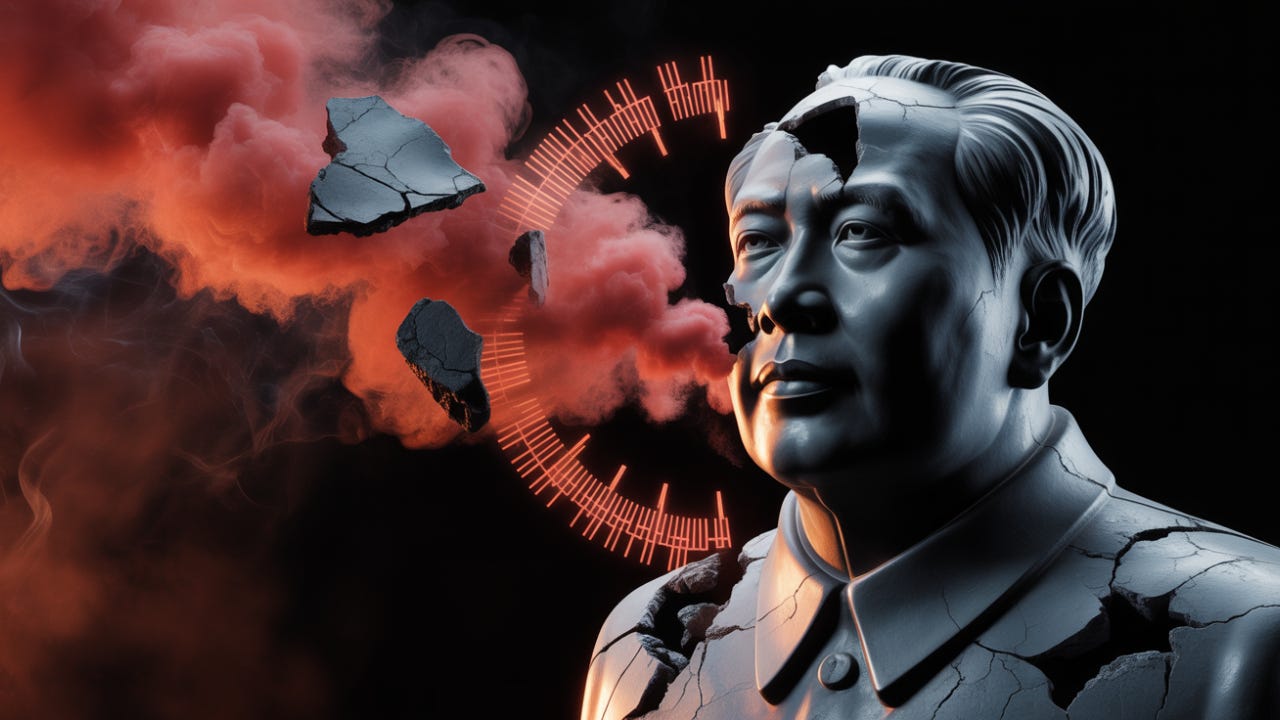
Most risk forecasts fixate on events. An invasion. A recession. A diplomatic rift.
But some of the most dangerous threats aren’t events at all—they’re ideas. Not just the ideas a regime says aloud, but the ones it acts on without ever questioning.
The Chinese Communist Party operates according to a set of beliefs: some inherited, some deliberately engineered, and others growing increasingly detached from reality. These ideas shape how it governs decline, signals strength, and courts miscalculation.
So as we head into 2026, here are the ten most dangerous ideas still operating inside Beijing’s strategic imagination.
These ideas are dangerous because they are actively believed by those in power, and acted on as truth.
1. “Loyalty can replace competence.”
In the Xi era, the highest virtue is obedience. Loyalty is the ultimate career currency. Promotions go to those who demonstrate deference, not those who show foresight or deliver performance. After multiple waves of purges, especially following the 2023 defense and financial sector sackings, the CCP is hollowing out its own executive function.
Why it persists: Xi fears factionalism more than stagnation. A yes-man who keeps the peace is preferable to a reformer who rocks the boat.
Strategic danger: This fragility runs deep. Systems built on fear suppress early warning signals and remain silent until the moment of collapse.
2. “Conflict is cheaper than reform.”
Real estate reform would wipe out $50 trillion in household wealth. A Taiwan crisis costs nothing and blames foreigners for the pain already coming. But conflict—diplomatic, economic, or even military—is politically efficient. You can blame it on foreigners. You can rally nationalists. You can justify new tools of control. In Beijing’s mental map, managed conflict is cheaper than systemic change.
Why it persists: The post-Zero-COVID legitimacy vacuum is real. Crisis generates narrative cohesion faster than policy.
Strategic danger: War becomes a tool of domestic governance, not foreign policy. That breaks every predictive model.
3. “The world needs what we control.”
From rare earth minerals to critical infrastructure projects, the CCP sees its choke points—energy, logistics, commodities—as fixed leverage. They believe interdependence equals dominance. That the world can’t afford to walk away.
Why it persists: For two decades, this was true. Global actors rationalized bad behavior to preserve market access.
Strategic danger: Beijing will mistake symbolic entrenchment for strategic necessity. The moment that illusion breaks, retaliation is swift and unpredictable.
4. “Time is still on our side.”
For decades, the CCP has played the long game. “Bide time, hide strength.” But it’s no longer hiding anything, and time is no longer an ally. China will lose 200 million working-age adults by 2050. Youth unemployment hit 21% in 2023 before Beijing stopped publishing the data. Urban debt is accelerating. The social contract is fraying. Yet Beijing clings to the idea that history remains on its side.
Why it persists: It’s foundational to CCP ideology. Legitimacy rests on inevitability.
Strategic danger: The Party is governing as if it still has decades to stabilize the future. It doesn’t. This gap between perceived runway and real risk may be the most dangerous delta in global geopolitics today.
5. “Nationalism can outpace dissent.”
This is the regime’s emotional firewall. If things get bad, feed the people pride. But national pride no longer guarantees obedience, especially among China’s most capable: the tech elite, the urban middle class, the young.
Why it persists: Nationalist narratives are easy to manufacture. The machinery already exists: online censors, viral influencers, Red history campaigns, wolf warrior diplomats.
Strategic danger: Weaponized identity is combustible. The very audience the Party seeks to control may be the first to turn on it when the contradictions become unbearable.
6. “Tech obedience can substitute for trust.”
In Xi’s China, governance is increasingly outsourced to algorithms. Predictive policing, facial recognition, AI-enabled social credit systems—these are deployed not just to monitor behavior, but to shape it.
Why it persists: It works, until it doesn’t. The illusion of omniscience seduces leaders. Why invest in legitimacy when you can program compliance?
Strategic danger: Zero-COVID’s collapse took three days once protestors realized the cameras couldn’t arrest everyone simultaneously. Omniscience is brittle. An obedience machine doesn’t handle ambiguity well. And when people learn how to game it, or stop fearing it, the feedback loop collapses fast.
7. “Controlling the story means controlling the outcome.”
Beijing doesn’t just censor dissent, it engineers narrative space. It believes that if you control the frame, you control the fight. This idea fuels China’s global influence campaigns, Taiwan pressure tactics, and domestic propaganda strategies.
Why it persists: Propaganda has worked for decades. It helped maintain internal cohesion and project an aura of inevitability abroad.
Strategic danger: The CCP is increasingly confusing performance for power. Storytelling cannot reverse structural decline, but Beijing is now governing like it can.
8. “The United States is too divided to respond effectively.”
Xi’s advisors increasingly assume US dysfunction is a permanent feature. And in fairness, America has given them plenty of evidence: shutdowns, social fragmentation, policy whiplash. Beijing sees chaos and assumes weakness.
Why it persists: It’s comforting. It justifies risk-taking. It flatters China’s own system.
Strategic danger: It misses the US pattern of chaos, then convergence. Pearl Harbor unified an isolationist America in 72 hours. 9/11 produced near-unanimous Congressional authorization. Beijing sees 2025’s chaos but may miss the 2026 convergence signal when it comes.
9. “Taiwan can be psychologically isolated without a shot fired.”
No need for invasion. Just undermine morale. Flood the information space. Wage economic pressure campaigns. Isolate Taipei diplomatically. The idea is to slowly convince Taiwan it’s already lost, even if it hasn’t surrendered.
This belief fuels moves like Beijing’s new “Taiwan Restoration Day,” a state-sanctioned narrative weapon aimed at normalizing eventual annexation through historical inevitability.
Why it persists: It worked with Hong Kong. Beijing believes democratic resilience is thin.
Strategic danger: This assumption misreads Taiwan’s distinct political identity. Hong Kong had no army, no allies, no sovereignty. Taiwan has all three. Beijing is applying the wrong playbook to the wrong target.
10. “We can script the future through control.”
This is the CCP’s deepest illusion. That history is programmable. That with enough surveillance, censorship, and technocratic precision, they can eliminate chaos. That unpredictability is just a failure of planning.
Why it persists: It flatters the bureaucracy. It sustains the system. It’s a godlike vision of governance.
Strategic danger: Reality is messier than code. The more the Party insists on controlling everything, the more vulnerable it becomes to things it cannot script: black swans, internal betrayal, adaptive adversaries.
These ideas form a coherent belief system, one that fuses bureaucracy, ideology, fear, and performance into a method of strategic perception management. It doesn’t just shape how Beijing sees the world; it reinforces the conviction that the world can be controlled by shaping how it’s seen.
That belief is more than a liability. In the hands of a regime that treats risk as a tool, it becomes a trigger for strategic surprise.
Beijing won’t miscalculate because it feels threatened. It will miscalculate when these ideas collide with reality faster than the system can adapt. That collision is coming in 2026.
Coming next Tuesday:
Top 10 Fault Lines China Can’t Acknowledge (But You Should Watch Closely)
We’ll peak beneath the surface at the fractures Beijing won’t name, and why that silence is a strategic signal.